
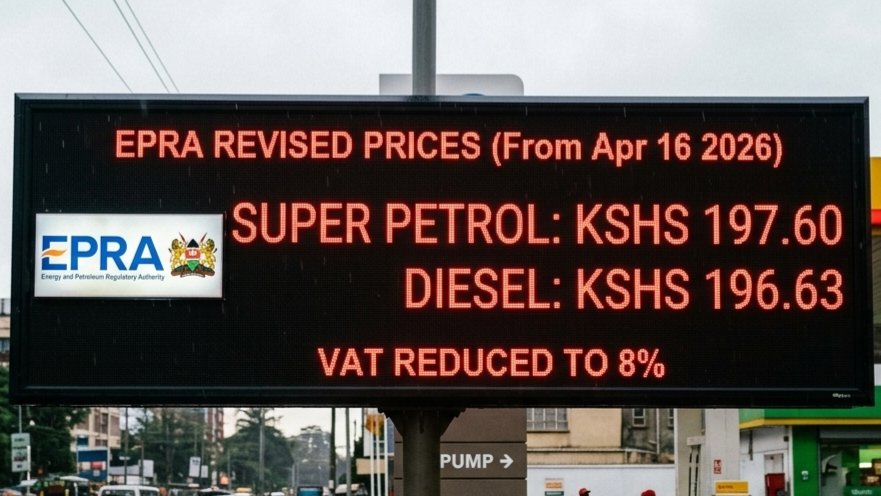

The Energy and Petroleum Regulatory Authority (EPRA) has issued an emergency addendum to its monthly fuel pricing schedule, forcing a downward revision of retail costs across Kenya. This shift follows Legal Notice No. 70, dated 15 April 2026, which saw the Cabinet Secretary for the National Treasury slash Value Added Tax (VAT) on petroleum products from 13 percent to 8 percent.
The adjustment is a direct response to a policy shift announced by President Ruto, aimed at mitigating the shock of global oil price volatility. Under the new pricing structure, which came into effect on 16 April 2026, the retail price of Super Petrol in Nairobi has decreased by KSh 9.37 per litre. Diesel, the primary fuel for construction equipment and heavy transport, has seen a more substantial reduction of KSh 10.21 per litre.
For the construction industry, where fuel typically accounts for a significant portion of project overheads, the revision brings the cost of diesel in Nairobi down to KSh 196.63 per litre. Super Petrol now retails at KSh 197.60. These figures represent a partial reversal of the record-breaking price hikes announced only 24 hours earlier, which had threatened to push operational costs to unsustainable levels for contractors.
In coastal regions, where logistics hubs for major infrastructure materials are centered, Mombasa residents will pay KSh 194.32 for Petrol and KSh 193.35 for Diesel. While these prices offer some relief, Kerosene prices have remained unchanged at KSh 152.78. EPRA noted that the subsidy level on Kerosene has been reduced from KSh 108.10 to KSh 96.56 per litre to accommodate the new tax regime.
The rapid succession of legal notices—moving from a 16 percent VAT rate to 13 percent, and finally to 8 percent within 48 hours—highlights the volatility facing the energy sector. This 8 percent rate is expected to remain in force until 14 July 2026, aligning with a three-month window intended to stabilize the domestic economy against rising landed costs.
Project managers and haulage companies must now recalibrate their budgets to reflect these changes. Although the reduction is a welcome development for active sites, the underlying landed cost of fuel remains high due to geopolitical tensions in the Middle East. The government continues to utilize the Petroleum Development Levy to further cushion consumers, applying various stabilization factors to prevent prices from exceeding the KSh 200 mark in most urban centers.
The updated price list, according to EPRA Director General Dr. Joseph Libondo, will be in force until 14 May 2026. This period will be crucial for the construction sector as it assesses the long-term viability of current contract pricing and material delivery schedules under the revised energy costs.
Comments (0)
Leave a Comment
No comments yet. Be the first to share your thoughts!