
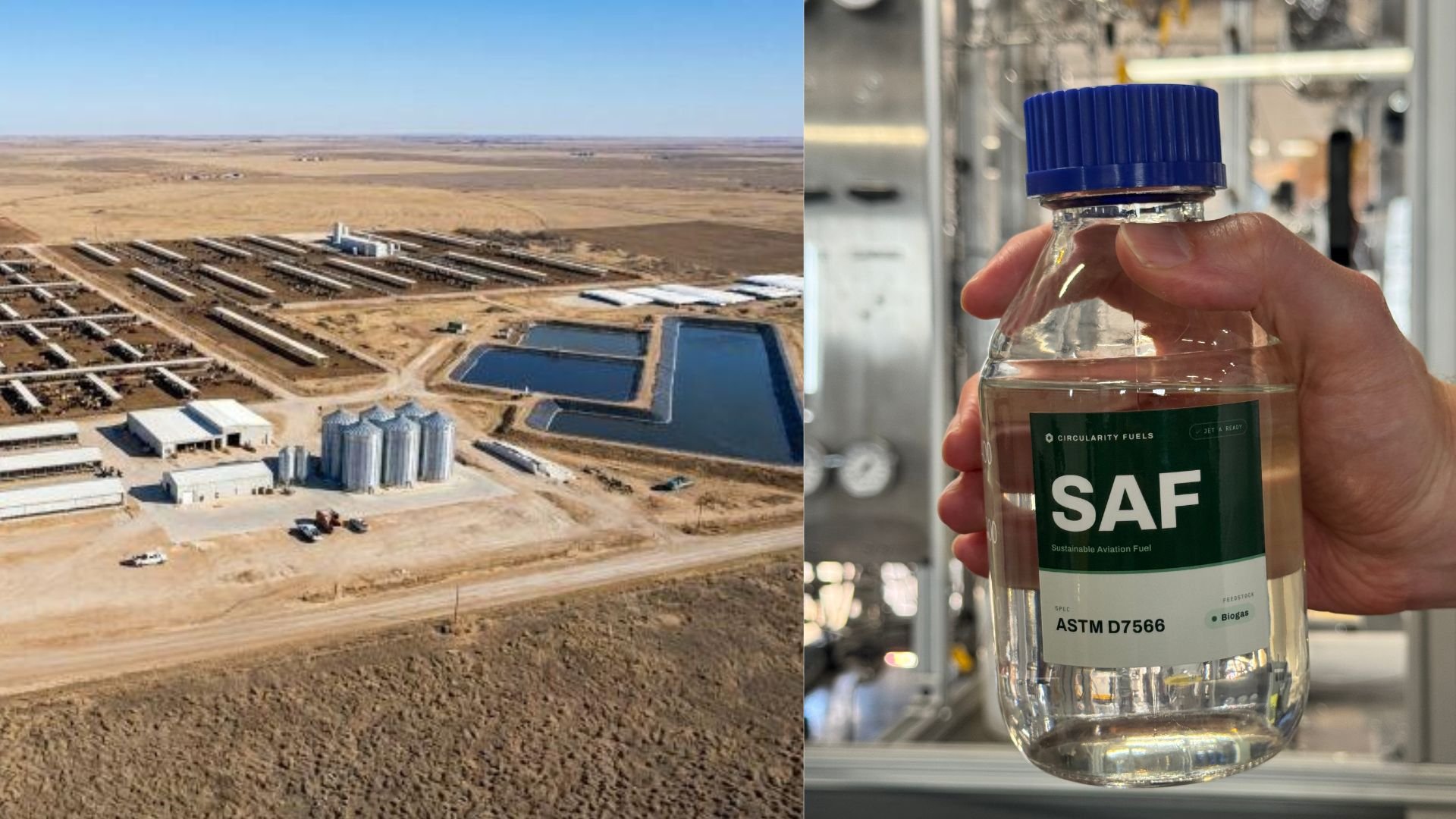

A California energy startup has completed a six-month pilot project converting raw agricultural biogas from a dairy farm into certified sustainable aviation fuel. This development represents a global technical milestone in the production of low-emission transportation fuels.
The initiative by Circularity Fuels, which is based in Redwood City, processed raw manure emissions directly on-site at a dairy farm near Madera, California. The facility handles more than 5,000 head of cattle, where manure digesters capture waste gases.
During the extended trial, the modular processing system operated for thousands of hours on untreated biogas, which consisted of roughly 65 percent methane and 35 percent carbon dioxide. The resulting synthetic fuel successfully met international safety and performance specifications.
Specifically, the fuel achieved compliance with the ASTM International (ASTM) D7566 Annex A1 standard. This certification ensures that the synthetic paraffinic kerosene can be blended at up to 50 percent with conventional Jet-A fuel, without damaging commercial aircraft engines.
Historically, the high concentration of carbon dioxide in raw agricultural methane has been a major barrier, because it required millions of dollars in specialized cleaning hardware and proximity to commercial pipelines. The new modular approach bypasses these infrastructure constraints entirely.
The system relies on a skid-mounted dual-reactor stack that pairs an electrified bi-reforming reactor with a compact synthesis reactor. In a single step, the specialized setup achieved a 98 percent methane conversion rate and a 90 percent carbon dioxide conversion rate.
According to corporate projections, this farm-scale technology can manufacture sustainable aviation fuel (SAF) at an installed capacity capital cost of under $100,000 per barrel-per-day. This expenditure is approximately one-fifth of the setup costs required by processing facilities currently under construction in Europe.
Lowering manufacturing facility costs allows the waste-derived synthetic fuel to compete directly with conventional fossil fuel pricing. The economic shift could transform waste management for dairy operators, who typically vent or flare their excess biogas into the atmosphere.
Dr. Stephen Beaton, who is the Founder and Chief Executive Officer (CEO) of Circularity Fuels, stated that the primary challenge was demonstrating continuous, economical production using real agricultural feedstock under practical field conditions rather than just proving a concept.
Beaton previously served as the Lab Chief of the United States Air Force (USAF) Petroleum Office. His company emerged from the DCVC incubator program, which supported it with $8 million in seed funding alongside awards from the National Science Foundation (NSF).
Environmental modeling indicates that the fuel achieves an exceptional lifecycle carbon intensity score of negative 350.7 grams of carbon dioxide equivalent per megajoule, which is achieved by capturing volatile methane that would otherwise escape into the global atmosphere.
The company calculates that every gallon produced removes roughly 100 pounds of carbon dioxide equivalent from the air, but the environmental benefit positions the fuel to qualify for lucrative federal and state subsidies, including the Environmental Protection Agency (EPA) Renewable Fuel Standard (RFS).
It also aligns with the Low Carbon Fuel Standard (LCFS) pathway in California, which provides financial incentives for carbon-negative energy production. Global SAF supply currently accounts for less than one percent of total aviation fuel demand, leaving a massive market open.
Most alternative fuel production relies heavily on used cooking oil, but feedstock availability limits its scalability. The utilization of abundant agricultural waste streams provides a highly scalable alternative for airlines trying to meet strict international sustainability mandates.
Circularity Fuels intends to break ground on its first commercial-scale agricultural processing installations in 2027. The company is actively evaluating potential expansion sites across major dairy and agricultural regions in the United States, Latin America, and Europe.
Comments (0)
Leave a Comment
No comments yet. Be the first to share your thoughts!