
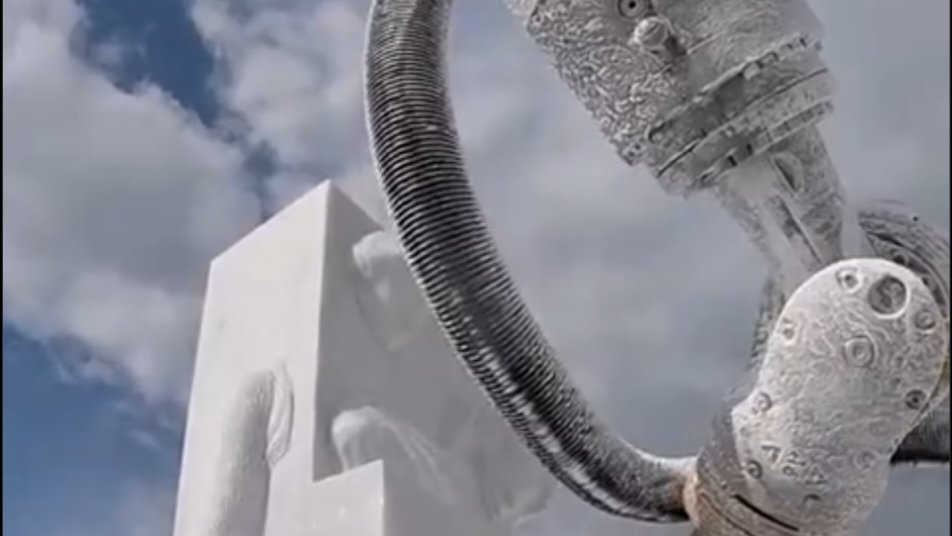

A robotics firm in Carrara, Italy, completed a full-scale marble statue of the Greek goddess Tyche using advanced automation. The project demonstrates how high-precision stone carving continues to evolve beyond manual chiseling.
Robotor deployed a Computer Numerical Control (CNC) system to execute the fabrication process. The multi-axis robotic arm milled the entire sculpture out of a solid block of Carrara marble with minimal human intervention.
Technicians guided the initial design phase using software powered by Artificial Intelligence (AI). The cloud system calculated the necessary tool paths, which allowed the machine to carve complex contours autonomously without requiring constant manual programming.
The mechanical arm utilized diamond-coated milling heads to chip away excess stone. By rotating across multiple axes, it produced intricate folds and smooth curves, which replicated classical sculpting methods with digital accuracy.
Engineers designed the equipment specifically to handle harsh industrial conditions inside quarry workshops. Heavy-duty electrospindles mounted on the unit provided high torque, which prevented bit stalling while cutting through dense natural rock.
Founders Giacomo Massari and Filippo Tincolini established the technology company to automate laborious stone tasks. Their goal focused on protecting workers from physical strain, while also eliminating exposure to hazardous airborne silica dust.
Traditional quarry operations rely heavily on manual masonry, which often takes months or years to finish. Automated milling reduces production schedules significantly, which lets studios finish large architectural and artistic commissions within days.
Despite the high level of automation, human craftspeople still perform the final surface adjustments. Machine operations complete roughly ninety-nine percent of the bulk material removal, which leaves delicate textural finishing for experienced sculptors.
The integration of robotic automation into classical art forms has generated ongoing debates across the stone industry. While traditionalists argue that automated tools alter artistic authenticity, advocates maintain that technological aids have always assisted sculptors.
Historical figures like Michelangelo utilized quarry assistants to prepare large marble blocks before completing details himself. Modern developers argue that automated robotic arms serve a similar supportive role for contemporary studios and stonemasons.
Beyond fine art projects, automated stone milling technology is expanding into structural masonry and architectural restoration work. Automated systems can scan historical artifacts, which allows precise replicas to be produced for damaged heritage sites.
Contractors are examining these automated systems to streamline custom stone fabrication for large commercial developments. Specialized software allows teams to upload three-dimensional digital models, which converts design files directly into physical stone structures.
The system operates continuously without requiring frequent operator breaks during intensive milling operations. Built-in safety sensors monitor tool wear and material resistance, which prevents structural cracking during complex carving passes.
As digital fabrication tools become more accessible, stone supply chains are adapting to automated processing techniques. The successful completion of the Tyche statue proves that automated systems can handle complex three-dimensional masonry challenges.
Italian stonemasons continue to test new robotic configurations for larger architectural commissions. Industry observers expect automated stone carving tools to become standard assets across specialized construction and stone processing facilities worldwide.
Comments (0)
Leave a Comment
No comments yet. Be the first to share your thoughts!