
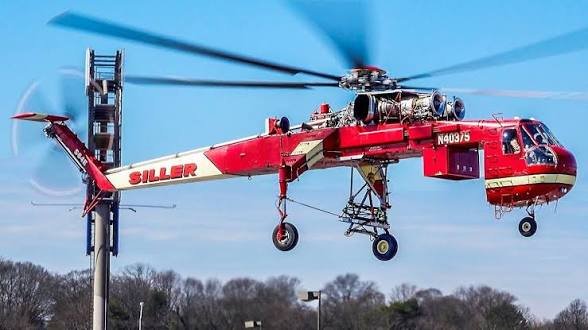

Airborne machinery remains essential for heavy infrastructure development, when ground transport is impossible. When roads cannot reach a remote site, the sky becomes the primary construction route. Among the most specialized tools for this task is the Sikorsky S-64 Skycrane heavy-lifting helicopter.
Developed originally by Sikorsky Aircraft Corporation (SAC), the twin-engine aircraft operates with a distinctive, skeletal airframe. This design removes the traditional cabin fuselage, which reduces empty weight. The narrow central spine allows operators to attach oversized external loads directly beneath the main structure.
The heavy-lift helicopter features a fully articulated six-blade main rotor system. Power comes from two turboshaft engines, which generate up to 4,500 shaft horsepower each. This immense propulsion enables the aircraft to lift external payloads weighing up to 20,000 pounds, depending on the specific model variant in service.
Industrial aviation firms employ these heavy-lift machines for complex utility infrastructure tasks, such as erecting high-voltage transmission towers. The aircraft is also frequently used for installing large commercial heating, ventilation, and air conditioning (HVAC) systems on skyscrapers, where ground cranes cannot reach.
Precision during complex lifting operations is managed by a unique cockpit configuration. The cabin includes an aft-facing co-pilot station, which provides an unobstructed view of the cargo hook. This station allows the operator to control the helicopter, while focusing entirely on placing the load.
To minimize payload movement during flight, the aircraft incorporates an automatic stabilization system. This specialized stabilization allows the helicopter to hover with exceptional accuracy, even when operating in challenging weather conditions, or over mountainous terrain.
While originally designed for military logistics, the Federal Aviation Administration (FAA) granted civil certification for the heavy-lifter in 1965. This opened the doors for private engineering firms to adopt the aircraft for logging, pipeline construction, and civil engineering projects globally.
In remote regions where building temporary access roads is environmentally damaging, aerial crane operations provide an alternative. The method protects local ecosystems, because it eliminates the need for heavy bulldozers and trucks to clear pristine land.
The aircraft also features a wheeled landing gear system with a wide wheelbase. This landing gear provides lateral stability on uneven ground, which is crucial when support crews service the machine in the field. A standard support crew usually consists of six to eight personnel.
Erickson Incorporated later acquired the manufacturing rights for the aircraft, and they expanded its utility to include aerial firefighting. Modified versions carry an electronically controlled water tank, which can hold up to 2,650 gallons of water or chemical retardant.
The tank can be filled using a flexible draft hose in less than one minute, while the helicopter hovers over a water source. This dual-purpose capability makes the machine an invaluable asset for governments, that require both infrastructure support and disaster response.
Infrastructure projects in East Africa, including remote power line installations, often face severe geographic barriers. While regional agencies like the Kenya Urban Roads Authority (KURA) expand ground networks, certain mountainous or marshy terrains remain completely inaccessible to standard construction vehicles.
In these specific scenarios, specialized heavy-lift helicopters offer a viable path forward for utility firms. Using the sky as a corridor allows engineers to transport heavy steel lattice structures directly to their foundation sites, which accelerates project timelines.
Though operating costs for heavy-lift helicopters are higher than traditional transport, the reduction in preparation time often offsets the expense. Contractors do not need to spend months clearing paths, which saves significant labor costs and reduces project delays.
The Sikorsky S-64 Skycrane remains a premier example of specialized engineering, proving that aerial solutions are indispensable for modern infrastructure. As global projects push further into isolated territories, the reliance on these flying cranes will continue to dictate the pace of remote logistics.
Comments (0)
Leave a Comment
No comments yet. Be the first to share your thoughts!