
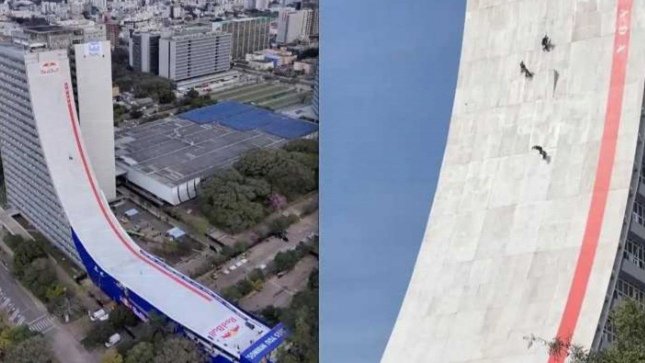

The Red Bull Building Drop project in Porto Alegre, Brazil, stands as a breathtaking convergence of architecture, engineering, and extreme sport. In an unprecedented move, the energy drink giant transformed the façade of the Administrative Center Fernando Ferrari (CAFF), a 1987 government landmark, into what is recognized as the world’s tallest skateboard ramp. This groundbreaking feat was far more than a publicity stunt; it was a meticulously engineered temporary construction that pushed the limits of design and safety, using the unique curvature of a high-rise to create a record-breaking sporting arena.
Rising an astonishing 85 metres, or 20 storeys, the ramp’s scale is unmatched in the world of skateboarding. It dwarfs previous mega-ramps, standing nearly three times taller than Danny Way’s famous 30-metre ramp built on the Great Wall of China. The challenge was immense: how could a curved, vertical surface be transformed into a safe, functional, and high-performance ramp capable of handling the tremendous stresses generated by a skateboarder plunging from that height? Every aspect of the project demanded precision, from the attachment systems to the ramp’s angle, balance, and aerodynamic profile.
Ensuring structural integrity was the central engineering task. The design team developed a robust steel support framework that could anchor securely to the existing skyscraper without compromising the building’s façade or structural safety. The ramp surface itself was built from specially treated materials to endure heavy impact loads, continuous vibrations, and strong wind resistance as the skater accelerated down the slope. Every connection and bolt was tested repeatedly to confirm its ability to handle the intense dynamic forces involved. The Building Drop thus became a showcase of modern temporary construction engineering, where innovation, speed, and precision came together to transform a city landmark into a colossal sports venue.
The ramp’s inauguration was equally spectacular. Six-time world vert skateboarding champion Sandro “Mineirinho” Dias made history by being the first to descend from the top of the CAFF tower. As he launched from the ramp, he reached an astonishing top speed of 147 kilometers per hour before landing flawlessly. His descent was not only a testament to human courage and athletic mastery but also living proof of the ramp’s impeccable design and the engineering team’s accuracy. The successful run validated months of technical planning and symbolized the perfect harmony between man and structure.
The Building Drop project also highlighted how effective collaboration between private companies and public authorities can make ambitious visions a reality. The Red Bull team worked closely with local engineers, safety inspectors, and city officials to ensure every element met Brazil’s strict construction and safety standards. The temporary structure was built and dismantled with minimal disruption to the daily operations of the government offices inside the CAFF building. This cooperation demonstrated that large-scale experimental constructions can coexist with urban environments when guided by expertise and mutual trust.
Beyond the spectacle, Red Bull aimed to leave a lasting impact on the community of Porto Alegre. As part of its social responsibility program, the company pledged to construct two modern public skateparks in the city. These facilities will provide young people with safe and accessible spaces to practice and grow the sport, ensuring that the excitement generated by the Building Drop translates into long-term benefits for local athletes and enthusiasts.
Ultimately, the Red Bull Building Drop serves as a vivid reminder that construction innovation is not limited to bridges, skyscrapers, or highways. It can also be a daring expression of creativity and human ambition. By turning an ordinary government building into a vertical playground for one of the world’s most daring sports, engineers and athletes together proved that the boundaries of possibility are only as high as the imagination dares to climb.
Comments (0)
Leave a Comment
No comments yet. Be the first to share your thoughts!