
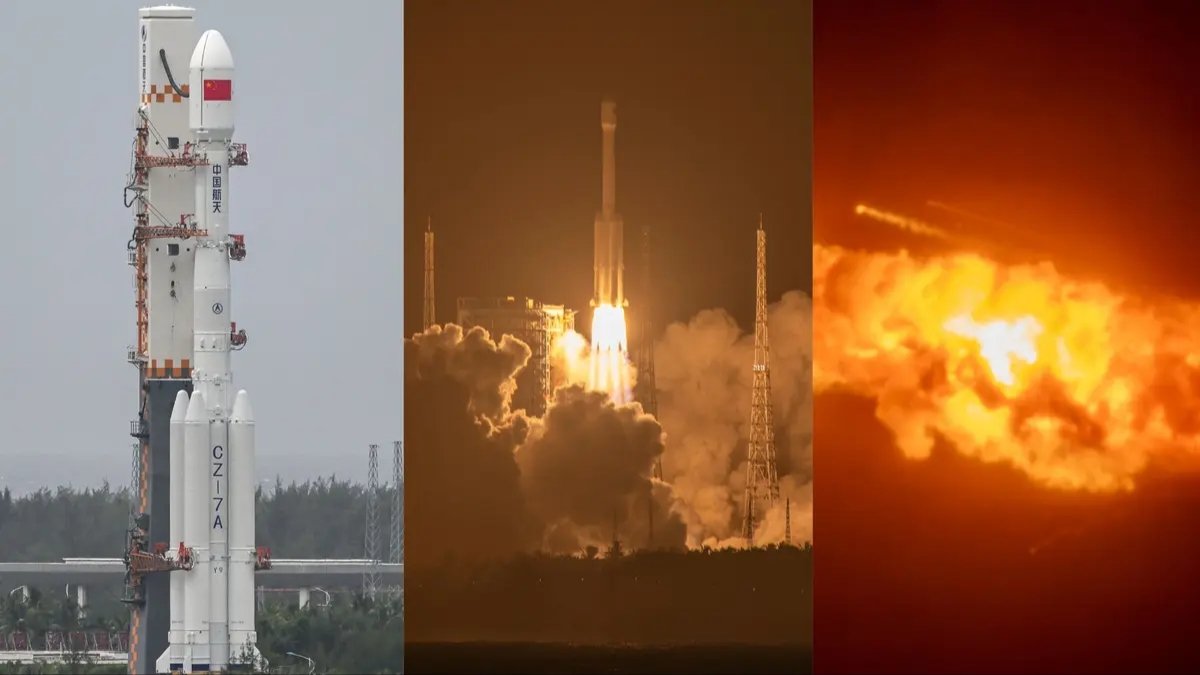

China's Long March 7A rocket broke apart roughly 85 seconds after liftoff on Monday, destroying the ChinaSat-4B communications satellite and ending a mission intended to deliver the spacecraft toward geostationary orbit.
The rocket launched from the Wenchang Space Launch Site on Hainan Island at about 8:02 p.m. Beijing time. The vehicle experienced an anomaly during its early ascent before erupting into a fireball and producing a trail of debris.
China's state news agency Xinhua later confirmed that the mission had failed, although authorities had not publicly identified the technical cause. An investigation is expected to determine what went wrong.
The failure is significant because the Long March 7A has developed a strong operational record since its debut in March 2020. The mission represents the rocket's first reported failure.
The Long March 7A is designed for demanding missions requiring delivery of payloads toward high-energy orbits, including geostationary transfer orbits. Such missions require substantially more energy than launches into low Earth orbit.
ChinaSat-4B was the payload aboard the failed flight. The communications satellite was intended to provide communications services, including television and radio transmission. Its destruction means China has lost both the launch vehicle and the spacecraft that was supposed to enter orbit.
The incident also comes against the backdrop of an unusually active launch schedule for China's space programme. The previous Long March 7A mission had launched only about 12 days earlier, highlighting the rapid turnaround China has been pursuing with the vehicle.
That pace makes the failure an important engineering setback, but not necessarily a reversal of China's broader space ambitions. The country has continued expanding its launch infrastructure, increasing launch frequency and developing vehicles capable of sending increasingly sophisticated payloads into higher orbits.
Wenchang has become an important part of that infrastructure. Located on Hainan Island, the spaceport is China's principal coastal launch site and is positioned to support larger rockets and missions requiring high-energy trajectories.
The Long March 7A itself is part of China's newer generation of launch vehicles. Its architecture combines technologies developed for the Long March 7 family with an upper stage intended to provide the additional energy required for high-orbit missions.
The failure therefore provides engineers with a significant amount of data to examine, particularly because the anomaly occurred so early in the flight. The vehicle was still in its initial ascent phase rather than approaching the later stages of the mission.
For China's commercial, civil and government space programmes, reliability is increasingly important as launch frequency rises. Each successful mission depends on the performance of complex propulsion, guidance, structural, electrical and communications systems operating together under extreme conditions.
Rocket failures are not unusual in the development and operation of space launch systems. What matters for the programme is identifying the failure mechanism, correcting it and determining whether other vehicles or components require inspection before subsequent flights.
China has experienced setbacks before while rapidly expanding its space capabilities, but the Long March family has also accumulated hundreds of successful missions. A communications satellite lost during launch is therefore a serious setback without, by itself, changing the trajectory of the country's broader space programme.
For now, the focus will be on the investigation into what caused the Long March 7A to fail just 85 seconds after liftoff and what changes will be required before the rocket returns to flight.
Source: Reuters, Associated Press and reporting on the August 10, 2026 Long March 7A launch failure.
Comments (0)
Leave a Comment
No comments yet. Be the first to share your thoughts!