
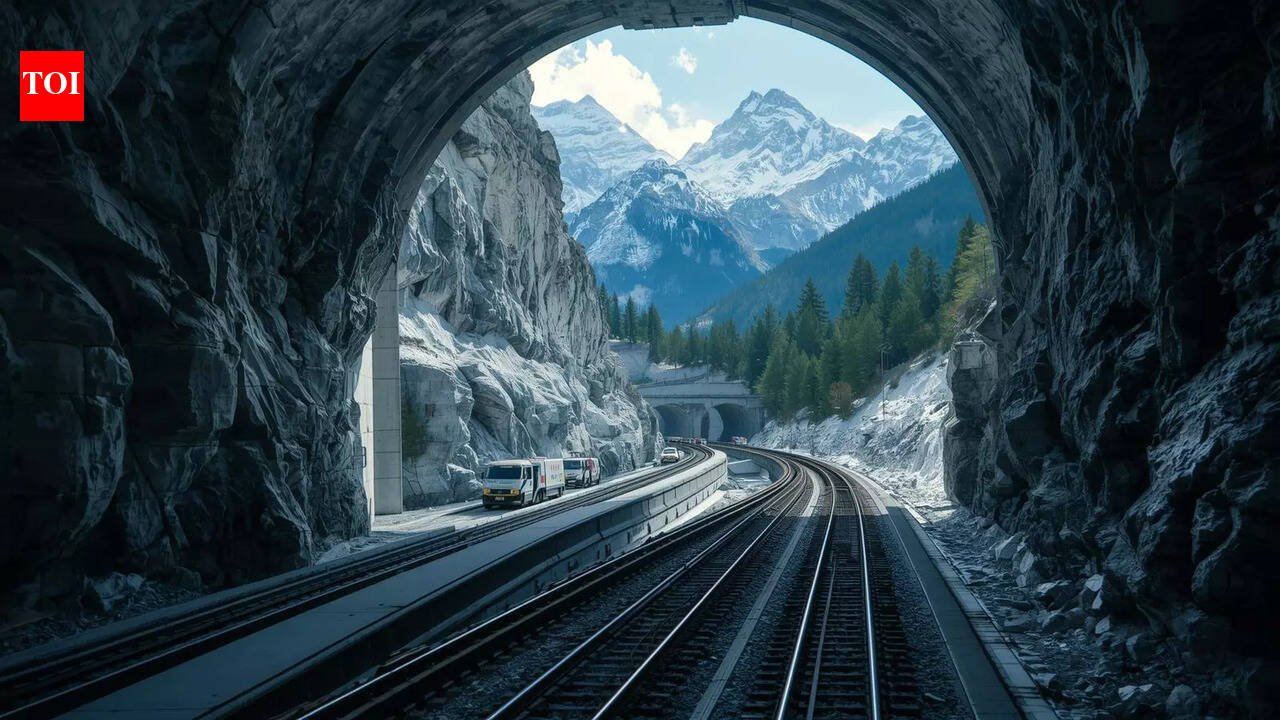

Switzerland's topography, dominated by the Alps, has long required engineers to build through rather than over the mountains. Over recent decades, this necessity has produced one of the world's most extensive underground transport systems. According to the Swiss Tunnelling Society, the country now counts around 1,852 tunnels of various types, with a combined length of about 2,544 kilometres. These passages include railway lines, roadways, hydroelectric drainage channels, and older utility structures.
More than ten percent of Switzerland's motorway and railway networks now operate below ground, a proportion that stands as a global high. Roughly 50 railway tunnels and 55 road tunnels exceed two kilometres in length, and this total continues to grow as new projects come online. The Gotthard Base Tunnel remains the most prominent example. Opened in June 2016, the 57-kilometre structure allows trains to pass beneath the Alps at a lower elevation than previous routes, shortening journey times and cutting energy consumption for freight and passenger services.
Construction patterns have shifted over time. From the 1950s onward, large drainage tunnels supported hydroelectric development. Road tunnels gained momentum in the 1980s, while railway tunnels received priority from around 2000. In certain areas, underground travel forms a substantial part of daily movement, reflecting the density of Switzerland's highway system and the challenges of surface routing through rugged terrain.
The sheer scale of this underground network is not immediately obvious from above ground. When measured by total length, it compares to the transport grids of major cities. Further expansions are under consideration, including longer railway connections in regions such as Zurich, Basel, Bern, Geneva, and Lucerne. These additions focus on relieving bottlenecks and integrating with existing infrastructure rather than pursuing only record-breaking lengths.
Engineers have maintained high safety standards throughout, incorporating twin tubes, frequent cross passages, advanced ventilation, monitoring sensors, and regular drills to address risks in such extended passages. Serious incidents remain uncommon due to these built-in redundancies.
Comments (0)
Leave a Comment
No comments yet. Be the first to share your thoughts!