

A version of this article appeared on Sara Al-saeed's Substack.
Regional influence in East Africa does not rely solely on population size or military dominance. Instead, geopolitical relevance comes from a state's capacity to integrate physical infrastructure, financial systems, and technology into a single operational network.
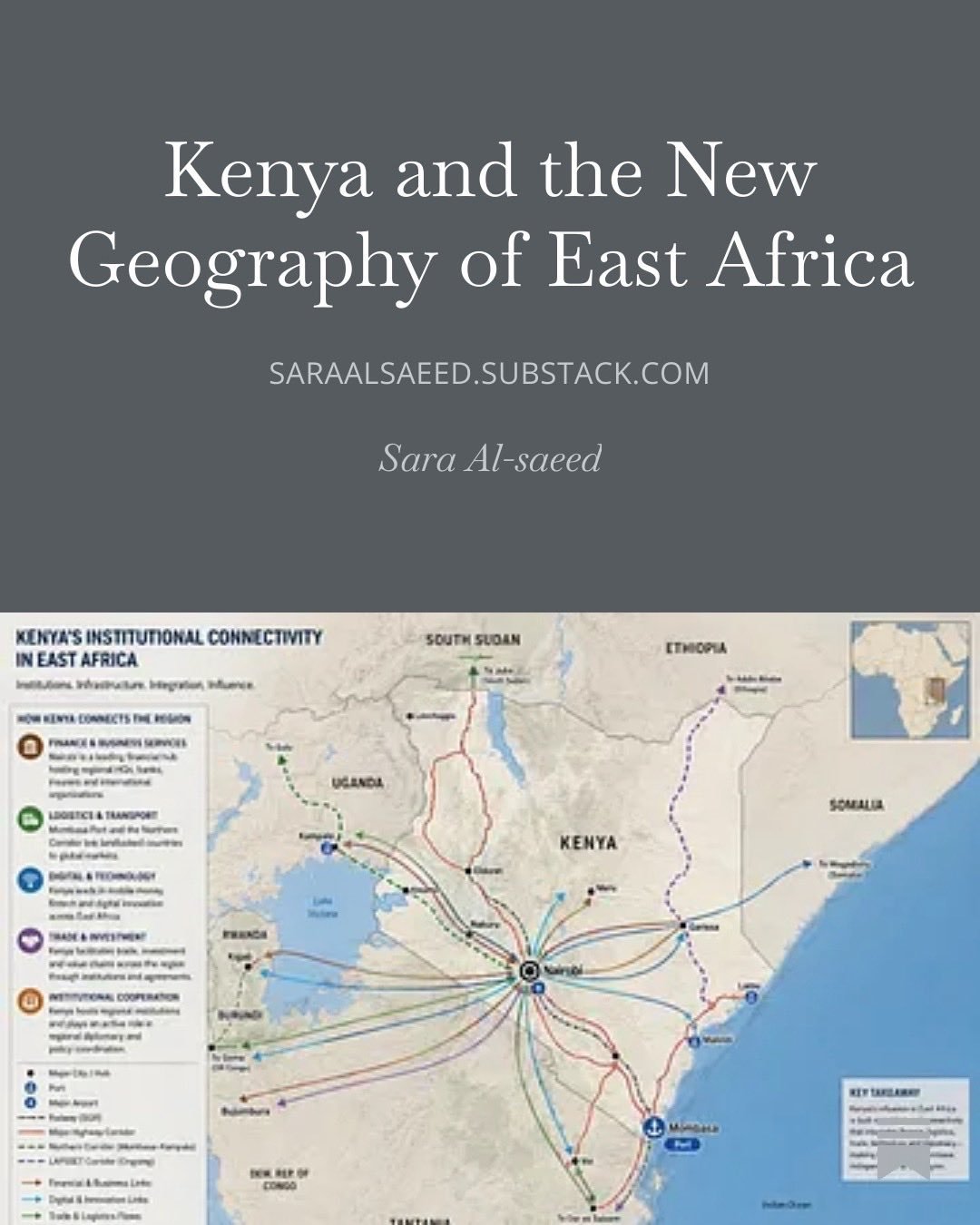
Kenya serves as a critical node connecting landlocked neighboring states to global supply chains. At the center of this integration is the Northern Corridor, a transport network that links the port of Mombasa to Uganda, Rwanda, and Burundi.
Sea freight landing at Mombasa Port moves inland via highways and the Standard Gauge Railway (SGR). This logistics network allows goods to flow across international borders, establishing the country as a central transit hub for East Africa.
Further north, the Lamu Port-South Sudan-Ethiopia Transport (LAPSSET) Corridor remains an ongoing infrastructure project designed to open up new trade routes. This ambitious corridor seeks to link Kenya with South Sudan and Ethiopia through dedicated roads, rail lines, and pipelines.
Beyond asphalt and steel tracks, digital infrastructure forms a crucial layer of regional connectivity. The country leads the region in mobile money deployment, fintech applications, and digital commerce innovation.
Financial services concentrated in Nairobi reinforce these physical and digital transport networks. The capital city hosts major regional corporate headquarters, commercial banking institutions, insurance firms, and prominent international organizations.
These institutions allow the country to organize cross-border finance, trade investments, and regional value chains effectively. Trade agreements and institutional cooperation frameworks further streamline the movement of goods and capital across borders.
Diplomatic engagement and policy coordination also play a vital role. By hosting essential regional institutions, Nairobi maintains an active voice in regional diplomacy and economic policy planning.
The integration of these five core pillars, including finance, logistics, digital technology, trade facilitation, and institutional diplomacy, defines the country's modern geography. Each pillar relies heavily on the performance of underlying infrastructure.
For instance, Mombasa Port handles millions of tonnes of cargo annually for regional markets. Efficiency at the port directly affects consumer prices and industrial manufacturing timelines in landlocked nations like Uganda and South Sudan.
The SGR line from Mombasa to Suswa provides a reliable freight alternative to long-haul road transport. It reduces transit times significantly, lowering the cost of doing business within the East African Community (EAC).
Meanwhile, the LAPSSET project targets the untapped economic potential of northern and eastern parts of the country. Once fully operational, it will provide an alternative corridor to the congested Northern Corridor.
It will connect Lamu Port directly to Addis Ababa in Ethiopia and Juba in South Sudan. This expansion diversifies trade entry points along the eastern coast of Africa.
On the digital front, telecom infrastructure underpins mobile money platforms that cross national borders. Fintech innovations developed in Nairobi are regularly adopted by businesses throughout the wider region.
This technological footprint creates an interdependent economic ecosystem where regional businesses rely on Kenyan digital platforms. Consequently, financial transactions flow smoothly without traditional banking delays.
Institutional cooperation ensures that regulatory frameworks match physical capacities. Joint border posts and harmonized customs procedures help eliminate non-tariff barriers along major highways.
These collaborative efforts make transport corridors more predictable for international logistics firms. Predictability remains a key factor for foreign direct investment in East African infrastructure.
Nairobi also acts as the diplomatic anchor for regional infrastructure planning. Decisions regarding cross-border road designs, pipeline routes, and electricity interconnections are frequently negotiated in the city.
This concentration of decision-making power reinforces regional reliance on Kenyan institutional systems. The country shapes regional integration through practical logistics management rather than raw demographic power.
Comments (0)
Leave a Comment
No comments yet. Be the first to share your thoughts!