
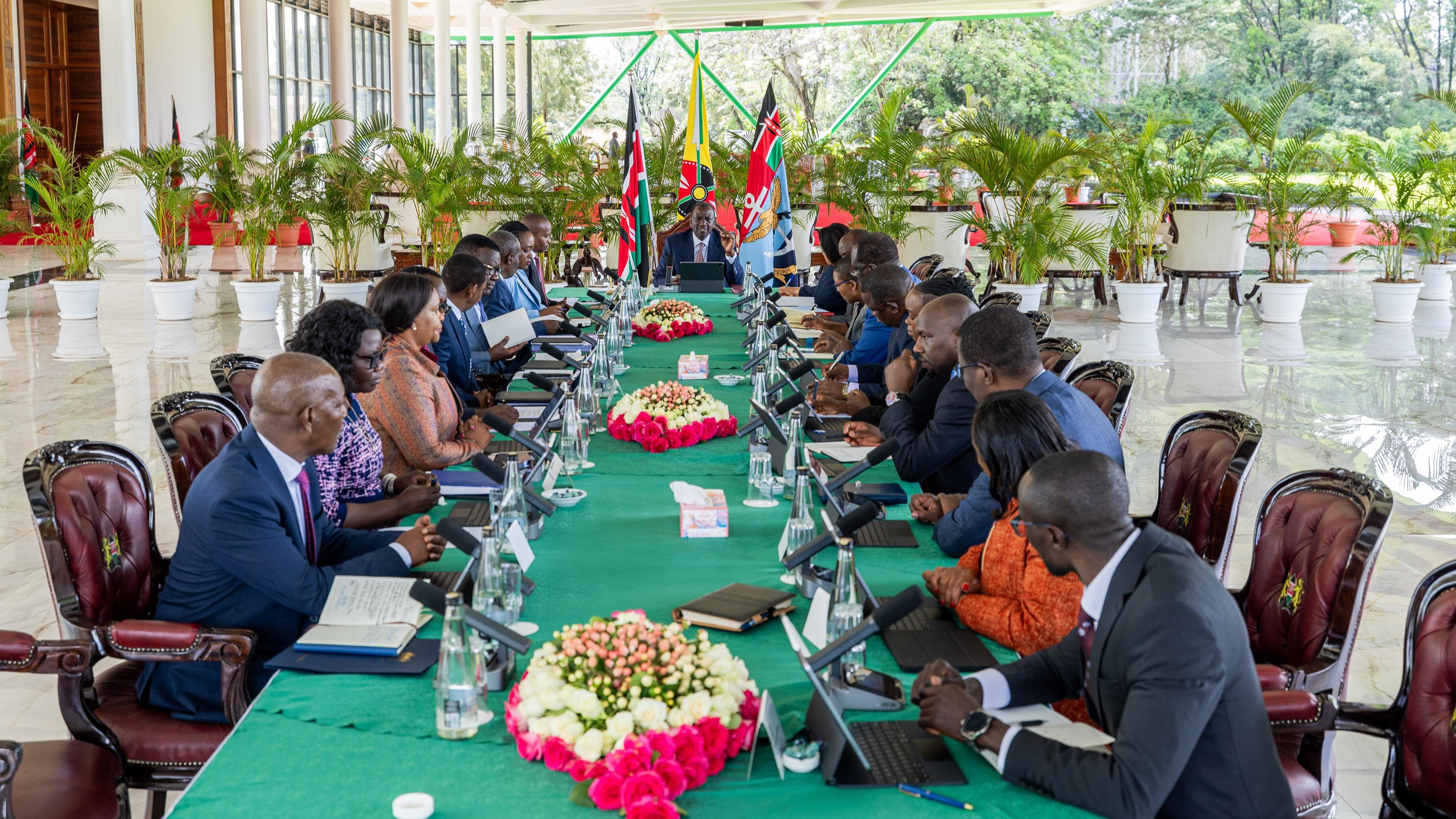

The Cabinet has approved a Sh4.7 trillion budget for the 2026/27 financial year, marking a Sh100 billion increase over the current fiscal period. In a dispatch released Tuesday following a session chaired by President William Ruto, the executive outlined a fiscal strategy that attempts to balance ambitious infrastructure goals with a widening revenue gap.
Total expenditure is projected at Sh4.7 trillion against a revenue target of Sh3.53 trillion. This leaves a deficit of approximately Sh1.17 trillion, which the government confirms will be plugged through a mix of domestic and external borrowing along with other financing instruments.
From the total expenditure, the recurrent budget accounts for the largest portion at Sh3.46 trillion. However, the development vote has been set at Sh749.5 billion. This capital allocation is earmarked for the construction of roads, bridges, and housing, alongside investments in energy and agriculture. The government intends to use this funding to transition from fiscal stabilization toward scaled up investment in physical assets.
The 2026 Budget Policy Statement identifies infrastructure as a core priority. Major works expected to draw from this pool include the continued expansion of the national road network under the Kenya National Highways Authority and the progression of the Bottom-Up Economic Transformation Agenda. Specifically, the state is looking toward public-private partnerships to supplement the Sh749.5 billion development fund, particularly for high-capital projects such as the dualling of major transit corridors and the extension of the rail network.
County governments are also positioned as significant players in the infrastructure cycle. Total transfers to the 47 devolved units are projected at Sh495.7 billion. This includes an equitable share of Sh420 billion and an additional Sh75.7 billion under the County Governments Additional Allocation Bill. A further Sh15.2 billion has been directed to the Equalization Fund, which traditionally supports basic services and infrastructure in marginalized areas.
Economic projections remains optimistic despite the borrowing requirements. The Cabinet forecasts a GDP growth of 5.3 percent in 2026, up from 5 percent in 2025. This outlook is predicated on favorable weather conditions and the performance of climate-smart investments. The government also noted that it will prioritize reforms in state-owned enterprises and digitisation to improve the efficiency of public spending on capital projects.
The budget documents will now be submitted to Parliament. Lawmakers are expected to deliberate on the allocations, particularly the balance between recurrent costs and the capital needed to sustain the construction sector. This fourth budget under the current administration serves as a transition point, focusing on completing existing projects while initiating new infrastructure under the national transformation framework.
Comments (0)
Leave a Comment
No comments yet. Be the first to share your thoughts!