
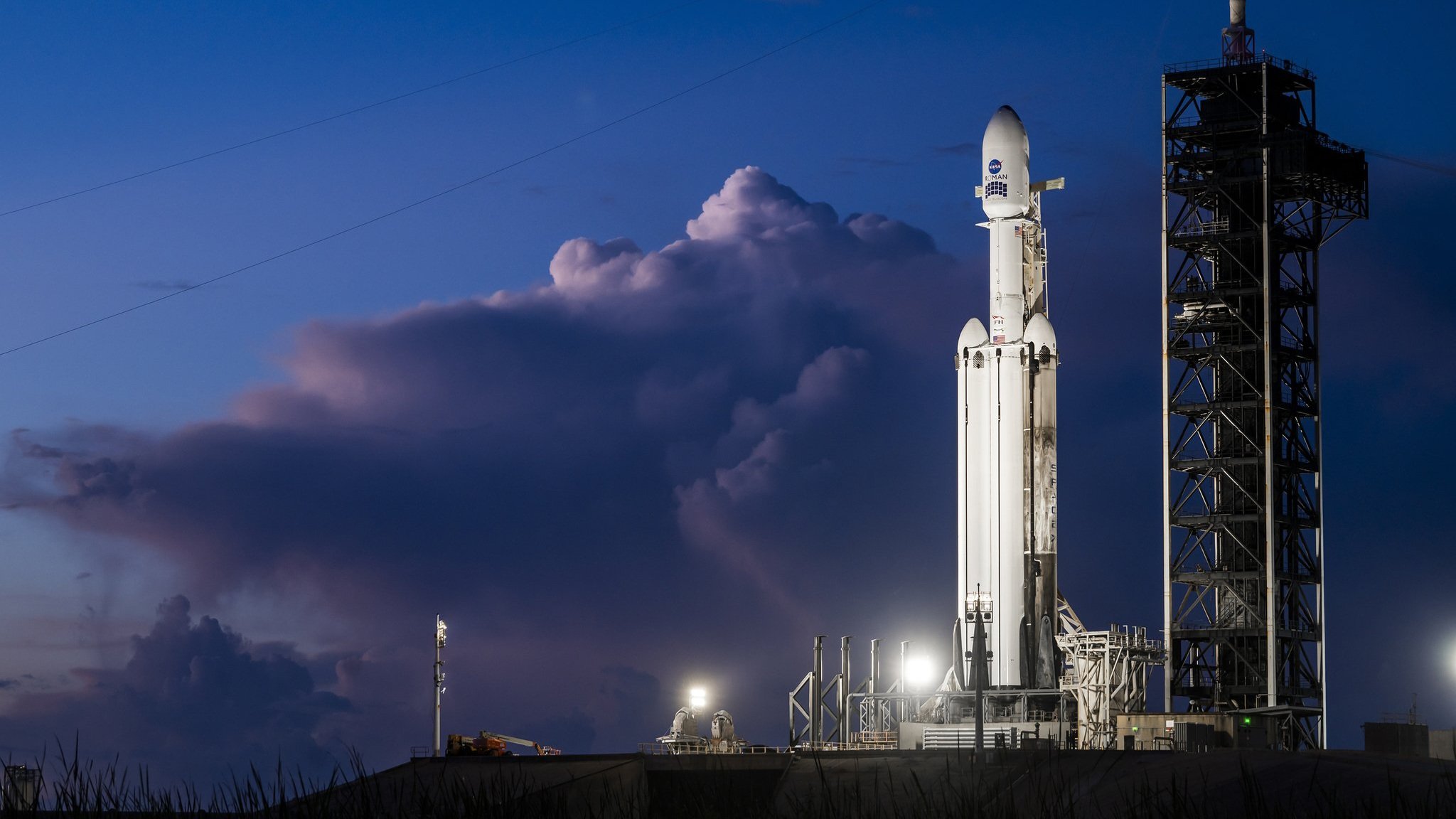

SpaceX has positioned its Falcon Heavy rocket vertically at Launch Complex 39A in Florida ahead of Sunday's scheduled launch carrying the National Aeronautics and Space Administration (NASA) Nancy Grace Roman Space Telescope into orbit.
The upcoming flight represents a critical operational deployment for heavy-lift infrastructure at the Kennedy Space Center (KSC) in Florida. Engineers rolled out the launch vehicle and raised it into position at the pad following integration procedures, preparing the hardware for final pre-flight checks, electrical verification, and propellant loading protocols ahead of the targeted countdown.
The mission payload, the Nancy Grace Roman Space Telescope, is designed to conduct extensive astronomical surveys from space. The observatory is instrumented to examine dark energy phenomena, search for extrasolar planets, and gather broad field observations across astrophysics disciplines.
Launch Complex 39A, originally constructed for Apollo Saturn V rockets and later modified for Space Shuttle operations, now serves as the primary East Coast facility for Falcon Heavy operations. The pad infrastructure includes a fixed service structure, an environmental control system for payload fairings, and specialized fueling systems engineered to handle the simultaneous fueling of three multi-engine rocket boosters.
SpaceX reported that ground crews completed vertical integration at the pad without public reporting of mechanical anomalies. The vehicle setup involves three primary core boosters bundled together, providing the total sea-level thrust required to propel heavy payloads beyond low-Earth orbit.
The Nancy Grace Roman Space Telescope mission requires a high-energy trajectory to reach its designated operational location. Once deployed by the upper stage, the spacecraft will utilize its aboard propulsion systems to complete transit to its targeted halo orbit around the Sun-Earth Lagrange point 2, located roughly 1.5 million kilometers from Earth.
This mission highlights the ongoing reliance on commercial launch services and dedicated ground infrastructure to execute complex scientific programs. The launching operation requires precise coordination between commercial operations personnel, federal range safety protocols, and civil space agency oversight.
Operational teams at Pad 39A will proceed through standard countdown benchmarks, including final arming sequence steps and automated propellant loading, leading up to the engine ignition sequence on Sunday.