
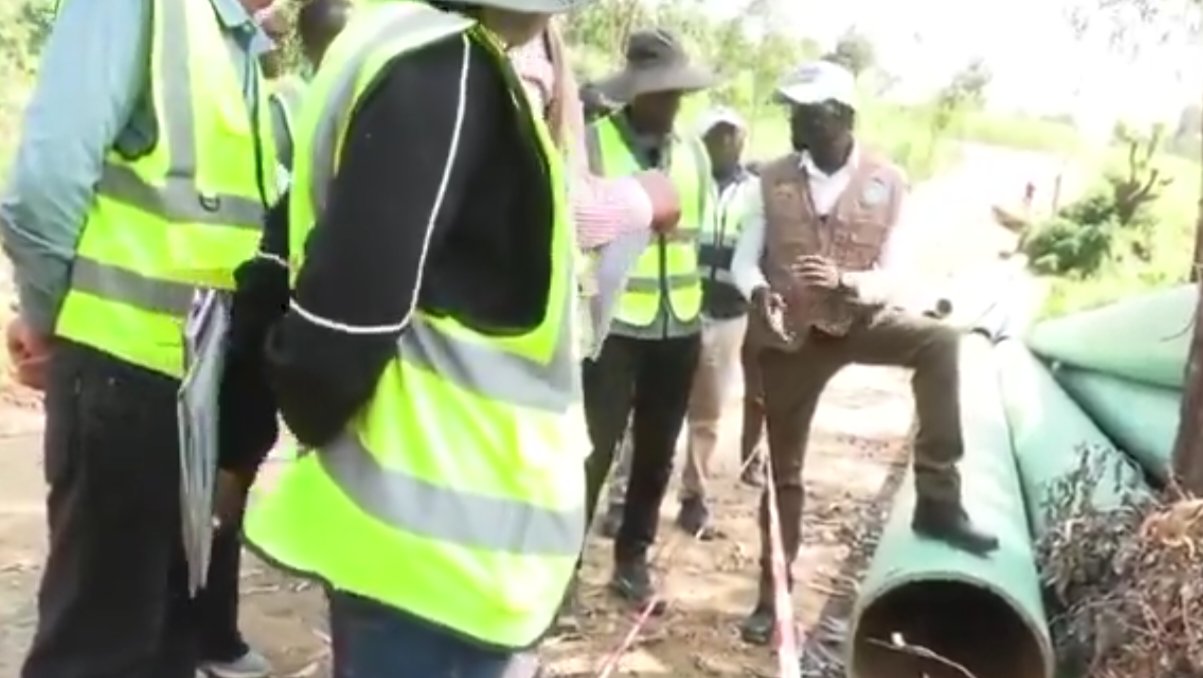

Engineers and contractors working on major water infrastructure projects across the country must exercise extreme care during pipe installation, Water, Sanitation and Irrigation Cabinet Secretary (CS) Eng. Eric Mugaa has advised.
Addressing site personnel during a field inspection, Eng. Mugaa noted that rust remains the primary threat to the structural integrity of large-diameter ferrous pipes used in water trunk lines.
To safeguard these assets, manufacturer designs incorporate protective coatings applied to both internal and external surfaces.
Maintaining the integrity of these protective layers is necessary to prevent premature corrosion and subsequent structural degradation once the pipes are laid. Eng. Mugaa emphasized that contractor handling during transport and positioning within trenches determines whether these protective barriers remain intact.
Large-diameter ferrous pipes are widely deployed in bulk water transmission schemes, where high pressure and variable soil conditions demand high tensile strength. Mechanical impacts or abrasion during site maneuvering can chip or breach the factory-applied protective coating.
KeRRA Board of Directors issues strict ultimatum to contractors over slow Nakuru road works
Exposure of bare metal to moisture and ground chemistry accelerates oxidation, leading to localized pitting, leakage, and premature failure of municipal water lines.
Preventing structural degradation requires rigid adhesion to standard handling protocols on construction sites. Engineering best practices mandate the use of padded slings, dedicated lifting equipment, and careful trench bedding to ensure the factory-applied protective layer stays completely intact during alignment.
The advisory comes as the ministry oversees several large-scale water transmission and distribution projects across the country. Maintaining strict quality control on pipe laying remains a standard requirement to prevent costly future repairs on national public utility networks.