
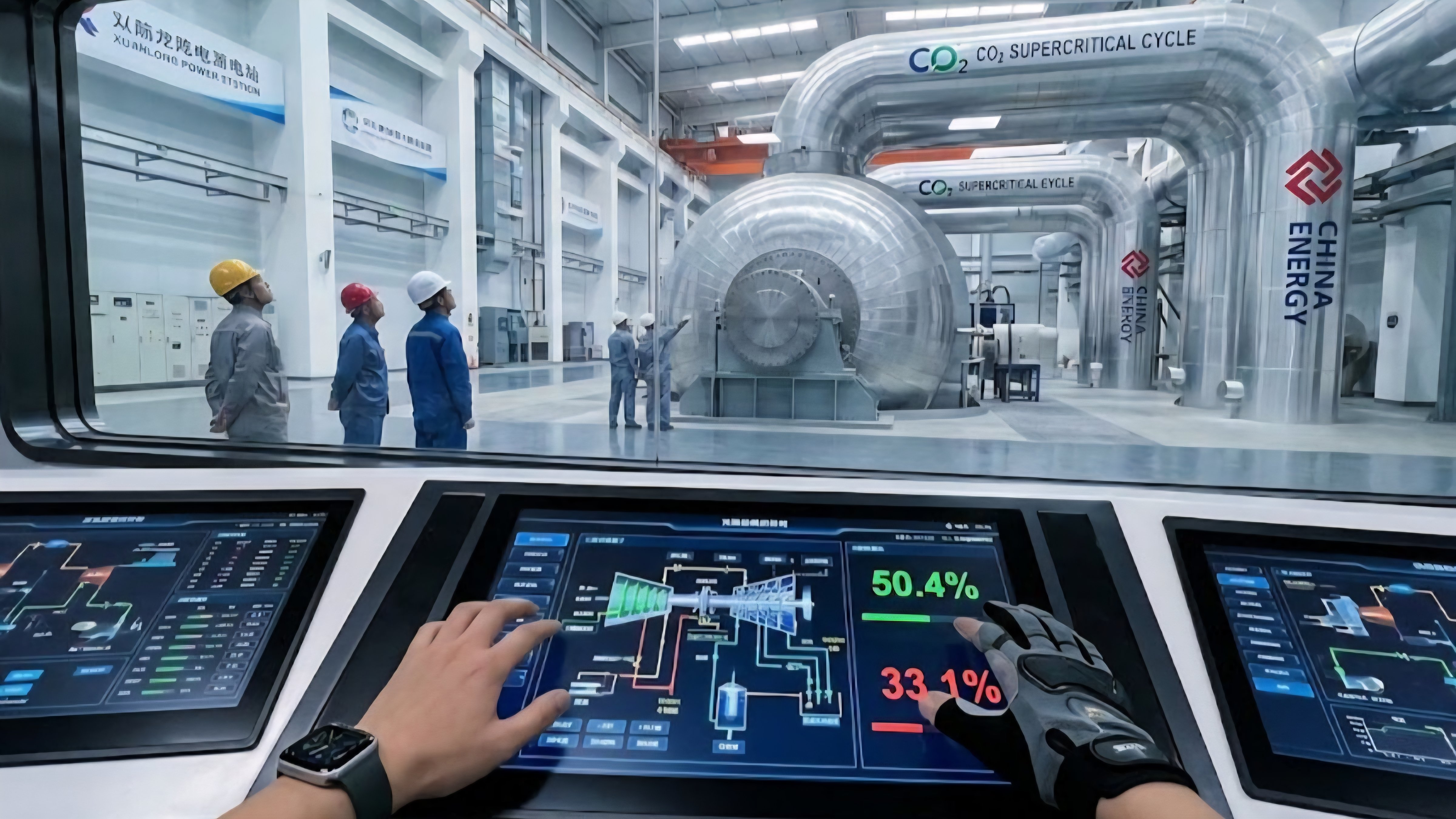

For more than two centuries, the global energy sector has relied on boiling water to produce steam and drive turbines. This process, while reliable, faces inherent thermodynamic limits. China now claims to have broken this mold with the successful trial of a 169-megawatt supercritical carbon dioxide (sCO2) generator.
The project, led by China Energy Investment Corporation, marks the first time this technology has reached a commercial scale. Unlike traditional plants that require massive boilers and cooling towers, sCO2 systems use carbon dioxide held at a specific temperature and pressure. In this state, the gas behaves like a fluid, allowing for much higher energy density.
Engineering teams at the site report that the sCO2 turbine is significantly smaller than a steam equivalent. Despite its reduced size, it operates at higher temperatures. This allows the system to convert heat into electricity more efficiently, reducing fuel consumption and emissions for every megawatt produced.
The core of the innovation lies in the physical properties of supercritical CO2. It is non-combustible and less corrosive than steam at high temperatures. Because the fluid is so dense, the turbines can be up to ten times smaller than those used in standard coal or nuclear plants. This footprint reduction could lower the capital costs of future infrastructure projects.
Global researchers have pursued sCO2 technology for decades, but scaling it from laboratory prototypes to a 169-megawatt facility presented massive technical hurdles. Managing the extreme pressures required to keep the carbon dioxide in a supercritical state demands specialized seals and high-strength alloys.
The successful synchronization with the power grid in late 2024 suggests these hurdles are being cleared. This development is particularly relevant for concentrated solar power and next-generation nuclear reactors. These systems require efficient heat transfer mechanisms that steam often fails to provide at very high temperatures.
Industry analysts suggest that if the technology proves stable over long-term operation, it could render traditional steam cycles obsolete. The ability to generate more power with less water is also a critical advantage in arid regions where cooling water is scarce.
While the current installation is integrated with a thermal plant, the technology is modular. Future applications could see these compact units deployed in remote areas or integrated into existing industrial sites to capture waste heat.
The Chinese team is now focused on monitoring the long-term durability of the turbine components. For a world still largely dependent on the 19th-century principle of boiling water, this transition represents a significant pivot in mechanical engineering and power plant design.
Comments (0)
Leave a Comment
No comments yet. Be the first to share your thoughts!