
The State Department for Irrigation has officially handed over the Nguruman Block B Irrigation Scheme in Kajiado West, a development covering 960 acres of land. Principal Secretary Ephantus Kimotho led the commissioning in Magadi Ward on Tuesday, where he highlighted the dual purpose of the new infrastructure. While the primary goal is to secure food production for approximately 800 local households, the project also incorporates critical river protection measures designed to mitigate the seasonal flooding that has historically plagued this region.
The Nguruman area sits at the base of the escarpment, where the Ewaso Ngiro South River often breaks its banks during heavy rains. For years, farmers in this horticultural hub have watched their crops of okra, tomatoes, and watermelons wash away. The engineering behind Block B addresses this vulnerability through enhanced river-bank stabilization and the construction of protective dykes. These structures are not just about irrigation; they are a hydrological defense for the entire Magadi community.
According to the Ministry of Water, Sanitation and Irrigation, the expansion into Block B is part of a broader strategy to utilize the fertile soils of the rift floor. The 960 acres now under management will benefit from structured water distribution systems, moving away from the more erratic traditional furrow methods used in the past. This transition allows for higher water use efficiency, which is essential in the semi-arid environment of Kajiado.
The 800 beneficiaries are largely members of the local community who have increasingly integrated crop farming into their traditional pastoralist lifestyles. This shift is seen as a vital buffer against the recurrent droughts that frequently decimate livestock herds in the region. By providing a reliable source of water and protecting the land from flood damage, the scheme creates a more resilient economic foundation for the residents of Magadi Ward.
PS Kimotho noted that the project is a direct response to the need for nutritional security. In the past, food supplies in Kajiado West were often imported from other regions or limited by the vagaries of the weather. The Nguruman scheme changes that dynamic by enabling year-round production of high-value crops. This not only feeds the local population but also supplies markets in Nairobi and the export sector, bringing much-needed cash flow into the county.
The technical specifications of the scheme include modernized intake structures along the river and a network of conveyance pipes that ensure water reaches the farm gates with minimal loss. Construction teams worked to reinforce the river channel upstream of the scheme, a move that engineers say will reduce siltation in the main distribution lines. Silt remains one of the greatest threats to irrigation longevity in this part of the country, and the new river protection measures are intended to extend the lifecycle of the infrastructure.
The commissioning of Block B follows years of planning and construction aimed at maximizing the potential of the water resources on the Nguruman Escarpment. The National Irrigation Authority has overseen the development, ensuring that the needs of the 800 farming families are met through sustainable land management practices. As climate patterns become more unpredictable, projects like this serve as a blueprint for how infrastructure can adapt to both excess water during floods and scarcity during droughts.
Local leaders in Magadi Ward welcomed the completion of the project, citing the previous losses incurred during the 2024 floods. They emphasized that the river protection works are as important as the irrigation pipes themselves. For the people of Kajiado West, the Nguruman Block B Irrigation Scheme is a promise of stability in an environment where the climate has often been an adversary.
With the project now operational, the focus shifts to farmer training and market linkages. The State Department for Irrigation indicated that extension officers will work with the 800 beneficiaries to optimize their yields and manage the new infrastructure. As the 960 acres begin to produce, the Nguruman scheme is expected to become a cornerstone of agricultural output for Kajiado, proving that with the right infrastructure, even the most arid regions can become productive food baskets.
Magadi Farmers Gain 960 Acres as Nguruman Irrigation Block B is Officially Commissioned
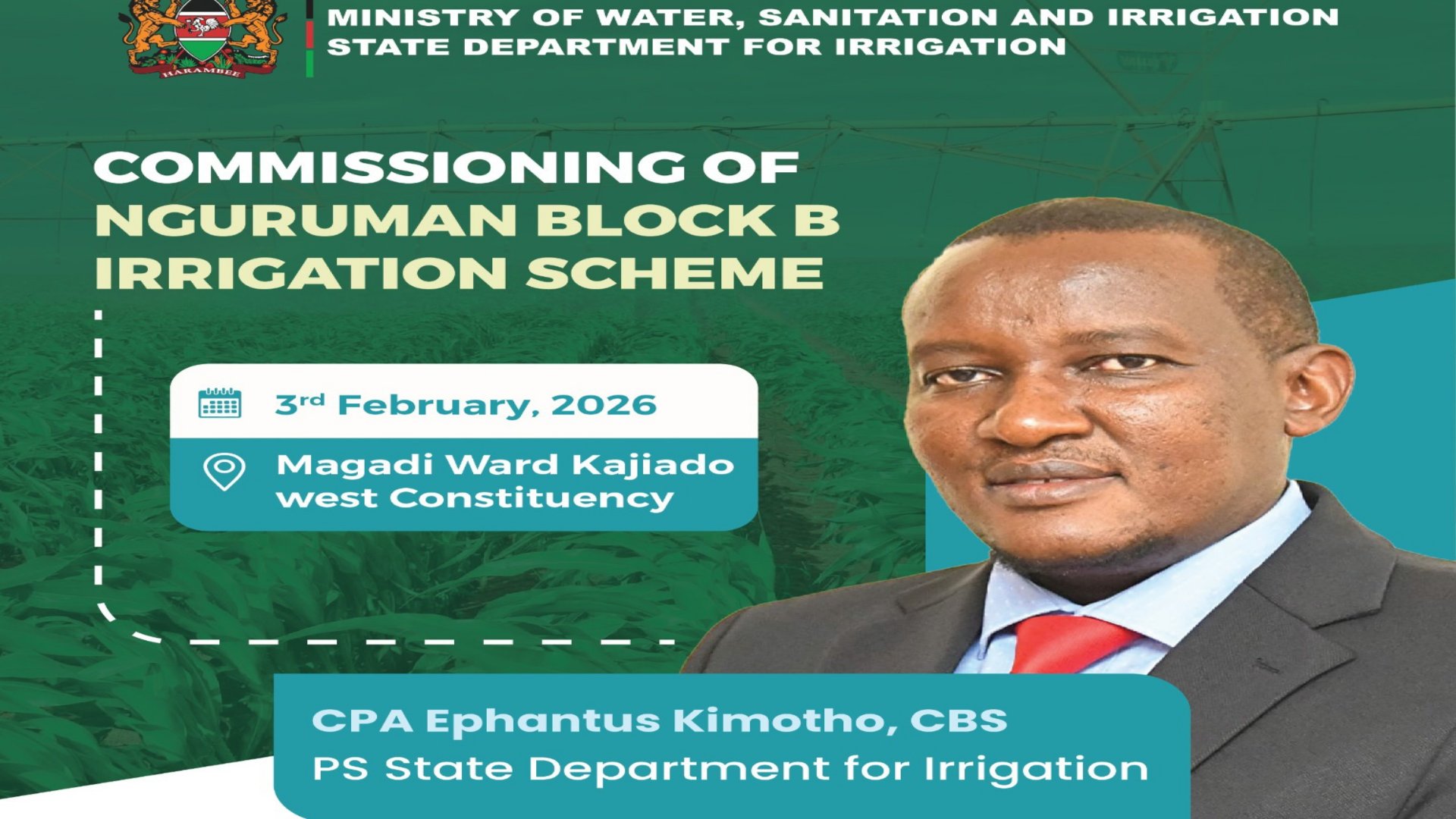
PS for the State Department for Irrigation, CPA Ephantus Kimotho, featured in an announcement for the commissioning of the Nguruman Block B Irrigation Scheme in Magadi Ward, Kajiado West.
|
HANDOUT

Principal Secretary Ephantus Kimotho commissioned the Nguruman Block B Irrigation Scheme on Tuesday, bringing 960 acres under cultivation and providing flood protection for 800 households in Kajiado West.
Comments (0)
Leave a Comment
No comments yet. Be the first to share your thoughts!