
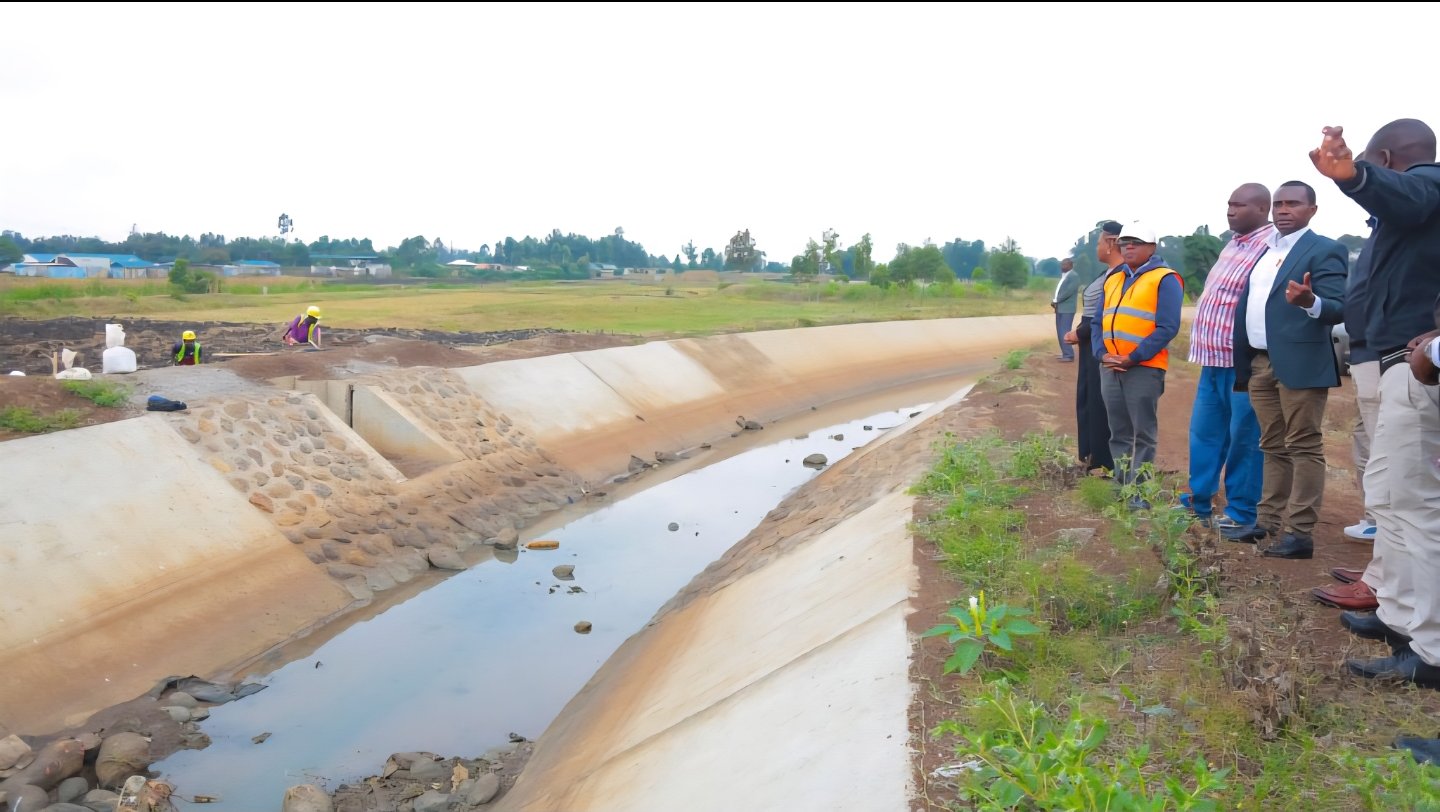

The State Department for Irrigation has officially handed over the rehabilitated Nguruman Irrigation Scheme Block B in Kajiado West, providing a reliable water supply to more than 10,000 farmers in the semi-arid region. Principal Secretary Ephantus Kimotho led the commissioning ceremony in Magadi Ward on Tuesday, noting that the project secures 960 acres of agricultural land previously vulnerable to environmental shocks.
The rehabilitation works were initiated in 2024 after heavy rains and flooding destroyed the existing intake points and traditional canal networks. These disruptions had rendered local farming unsustainable, forcing many residents to abandon crop production. The government intervention focused on the construction of modernized intake structures along the river and the installation of a reinforced conveyance system designed to withstand high-volume water flow during future rainy seasons.
By moving away from erratic traditional furrow methods, the scheme now utilizes modern drip irrigation technology. Technical teams at the site confirmed that the new infrastructure includes river protection measures to mitigate erosion and siltation. This transition allows for higher water use efficiency, which is a critical requirement for the semi-arid environment of Kajiado, where water scarcity often dictates economic stability.
During the handover, PS Kimotho explained that the project serves a dual purpose by stabilizing local livelihoods and reducing human-wildlife conflict. By ensuring consistent production within designated agricultural blocks, the scheme limits the need for farmers to encroach into wildlife habitats in search of water or fertile ground. The PS emphasized that planned irrigation infrastructure is essential for building climate resilience in regions where rainfall patterns have become increasingly unpredictable.
Farmers in the scheme are currently producing a variety of high-value crops, including okra, pawpaw, mangoes, and bananas, alongside staples such as maize, tomatoes, and kales. The project also integrates crop-livestock systems, allowing pastoralist communities to supplement their traditional livelihoods with irrigated agriculture. This diversification is seen as a key component in strengthening household food and nutritional security.
Kajiado West Member of Parliament, Joseph Sinkuyo, who accompanied the PS, noted that the successful rehabilitation of Nguruman Block B demonstrates the county's potential to contribute to national food security. He suggested that with continued investment in water harvesting and distribution infrastructure, the region could mirror the productivity of larger national schemes like Galana Kulalu.
The event was attended by senior government officials, including Irrigation Secretary Eng. Vincent Kabuti and the Director for Irrigation and Drainage, Eng. Bernard Onyango. The officials noted that the project aligns with the Bottom-up Economic Transformation Agenda, which prioritizes the expansion of irrigated land to reduce the country’s reliance on rain-fed agriculture.
Community leaders expressed relief after the works, citing the heavy losses incurred during the 2024 floods. The restoration of the canals has already led to an increase in agricultural yields for the domestic market, providing an immediate boost to household incomes in Magadi Ward. The government has committed to continued capacity building for the beneficiaries to ensure the long-term maintenance of the new infrastructure.
Comments (0)
Leave a Comment
No comments yet. Be the first to share your thoughts!