

A version of this article appeared on LinkedIn by Dr. Alex Owino, PhD.
Japan's offshore airports serve as a powerful reminder that civil engineering is not always about choosing the easiest ground.
Sometimes, engineers must select the most difficult ground because pressing urban problems demand it. In a country where usable land remains limited and cities are densely populated, constructing major hubs on reclaimed ground was an engineering response to specific pressures.
These projects directly addressed land scarcity, urban disruption, aircraft noise, and the necessity for future expansion. Kansai International Airport (KIA) stands as one of the boldest examples of this approach within the global aviation sector.
Built offshore in Osaka Bay, the facility helped preserve valuable urban land and significantly reduced direct noise impacts on nearby residential areas. From a soil engineering perspective, this project is often discussed because of settlement and ground performance issues.
But that is exactly what makes the project fascinating to professionals. Engineering is not only impressive when everything is easy and perfect.
Sometimes the real achievement is in pushing the limits of what is possible, learning from the ground, monitoring its behavior, and continuously adapting infrastructure to remain functional. That specific approach reflects the core of Japanese engineering thinking.
Project planners did not simply ask where the easiest place to build was. Instead, they asked how they could solve the urban problem while managing geotechnical risk.
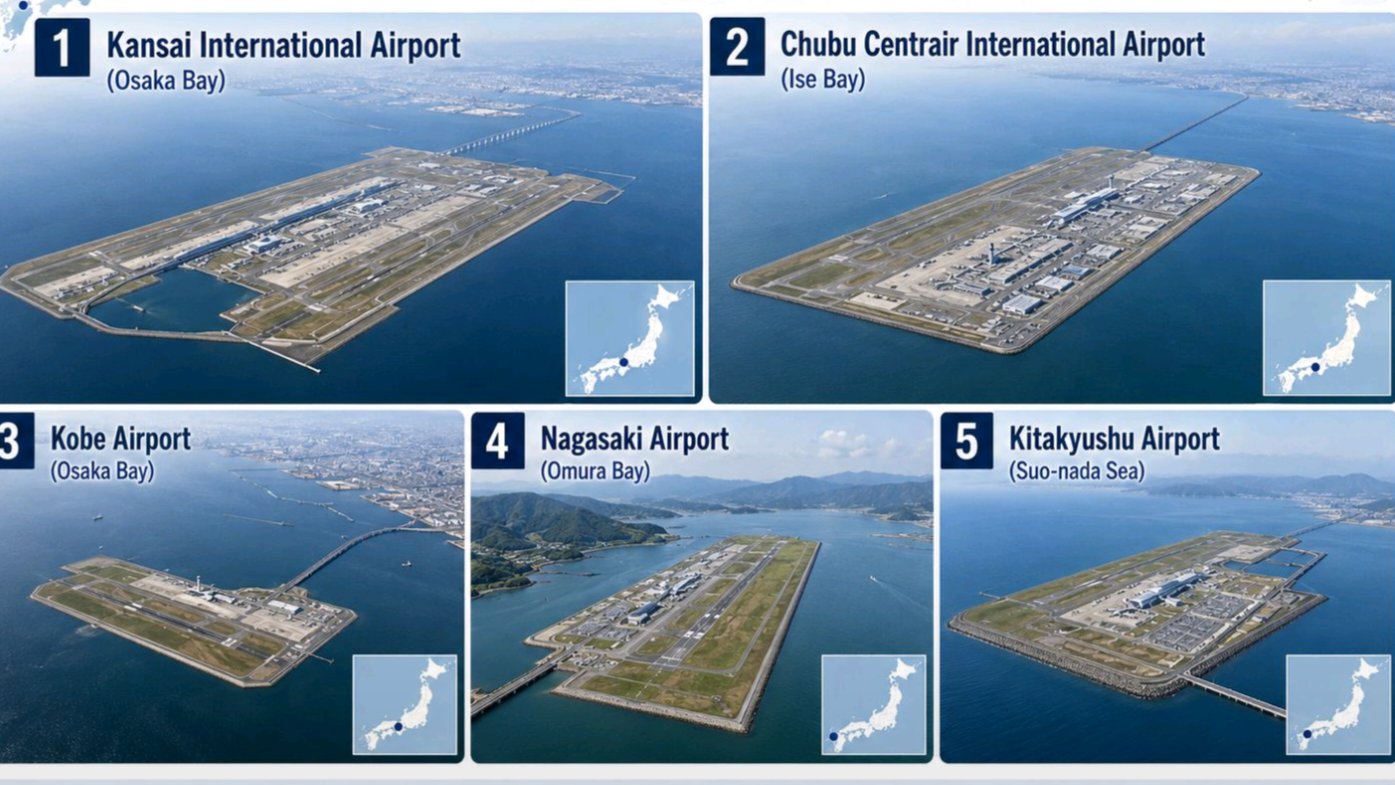
This mindset drove the development of Japan’s major offshore airports. These facilities include:
* Kansai International Airport,
* Chubu Centrair International Airport,
* Kobe Airport,
* Nagasaki Airport,
* and Kitakyushu Airport.
These massive projects show how closely civil engineering connects multiple vital disciplines. They successfully integrate:
* land-use planning,
* soil mechanics,
* marine construction,
* environmental consideration,
* and long-term infrastructure resilience.
For a civil and soil resources engineer, these developments represent much more than standard aviation facilities. They stand as lessons in bold engineering decision-making.
They remind the global construction industry that the ground is never just a passive foundation. The ground itself is always an active part of the story.
Achieving stable marine foundations requires extensive pre-loading and specialized sand drains to accelerate soft clay consolidation. Engineers must calculate long-term settlement rates over decades to protect runways from uneven sinking.
Wave action, typhoons, and seismic events present constant structural threats to these man-made islands. Continuous monitoring using advanced sensors ensures that sea walls and runway decks retain their structural integrity over time.
As urban centers globally face space constraints, Japan's reclamation methodology offers a clear blueprint for offshore civil infrastructure. These projects prove that technical innovation can turn geographical limitations into durable infrastructure solutions.
Comments (0)
Leave a Comment
No comments yet. Be the first to share your thoughts!