
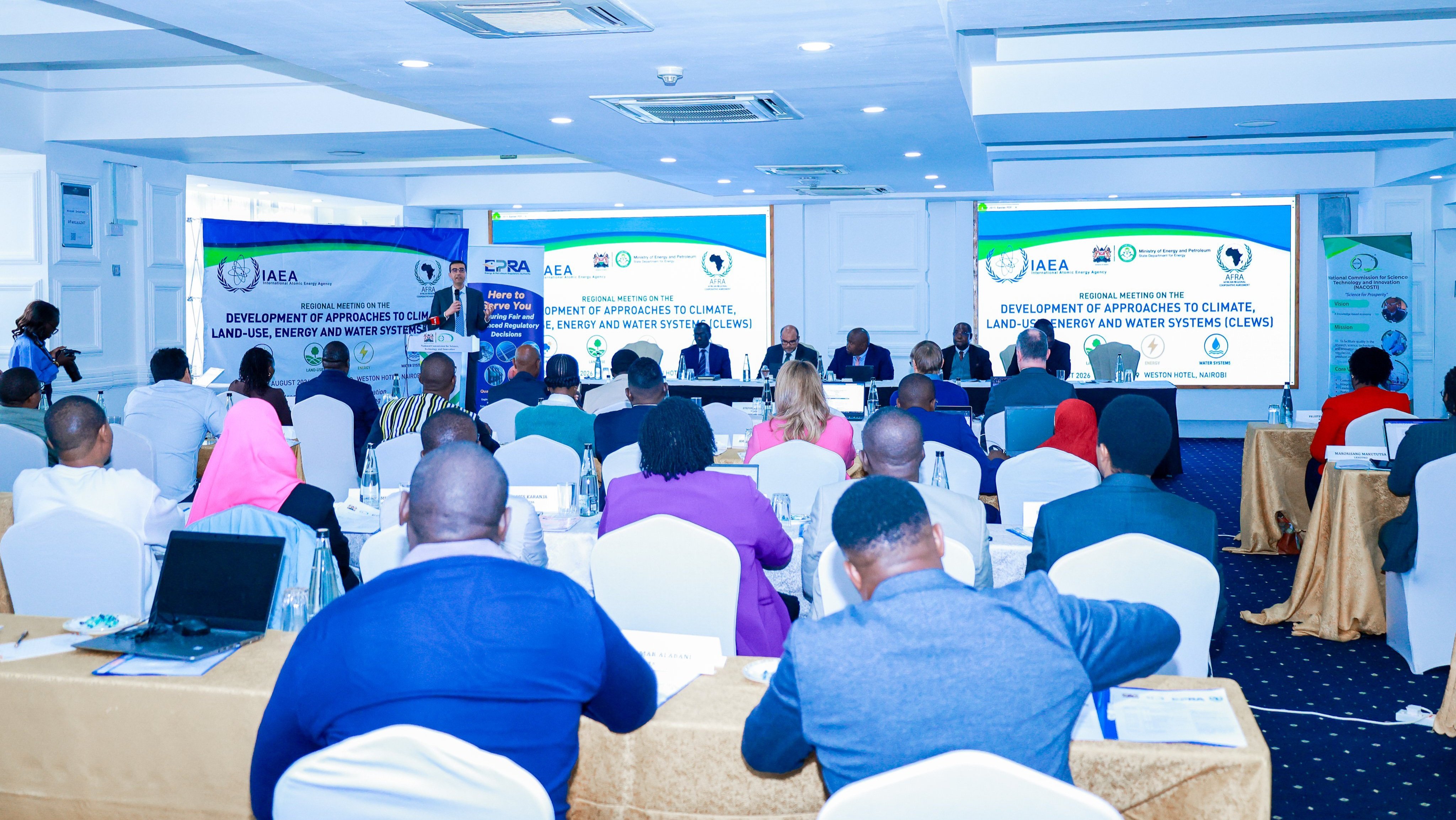

Energy and Petroleum Regulatory Authority (EPRA) Acting Director General Dr. (Eng.) Joseph Oketch joined regional and international experts early today for the opening of the International Atomic Energy Agency (IAEA) Regional Meeting in Nairobi.
The summit centers on developing approaches to Climate, Land-use, Energy and Water Systems (CLEWS), a structured framework designed to address resource management across interconnected infrastructure networks.
Welcoming delegates from across Africa, Dr. Oketch reaffirmed Kenya's commitment to integrated planning as a fundamental requirement for sustainable development.
He noted that climate change, rapid population growth, rising energy demand, and persistent pressure on land and water resources demand coordinated national solutions rather than isolated sectoral strategies.
Dr. Oketch emphasized that the Climate, Land-use, Energy and Water Systems (CLEWS) model serves as a necessary practical tool for understanding complex interconnections between resource sectors.
When regulatory agencies evaluate major power projects, cross-cutting environmental considerations often dictate long-term feasibility, grid stability, and overall resource allocation.
Energy regulators in developing economies increasingly face competing priorities when approving utility-scale generation and distribution projects.
Water scarcity directly impacts hydroelectric output and thermal cooling systems, while agricultural expansion frequently competes with land allocated for solar farms, transmission corridors, and geothermal installations.
The International Atomic Energy Agency (IAEA) created the framework to assist member nations in evaluating policy trade-offs before committing capital to major infrastructure projects.
By modeling resource interactions simultaneously, technical teams can prevent policy conflicts where energy sector targets unintentionally deplete municipal water reserves or undermine national agricultural land.
The Nairobi gathering brings together regional technical experts to standardize resource modeling across eastern and southern Africa.
Delegates are assessing case studies where uncoordinated planning created severe supply disruptions across connected power grids and municipal water distribution networks.
As climate volatility affects regional rainfall patterns, public utility planners require updated quantitative models to simulate seasonal stress on primary energy infrastructure.
The Energy and Petroleum Regulatory Authority (EPRA) maintains that adopting integrated assessment tools strengthens technical oversight, simplifies project licensing, and improves public infrastructure investment outcomes.
The conference continues this week in Nairobi, with technical sessions focused on practical implementation strategies for regional power utilities and resource planning ministries.
Comments (0)
Leave a Comment
No comments yet. Be the first to share your thoughts!