
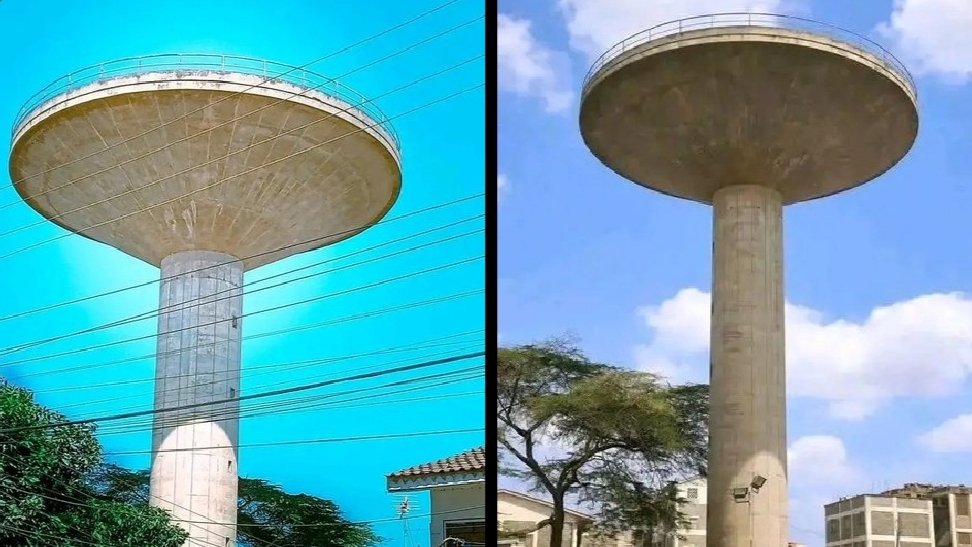

Social media users in Nairobi have long puzzled over a distinctive concrete structure in Donholm Estate. Many guessed it was an air traffic control tower or even a rocket launcher. Others simply asked what the mushroom-shaped landmark actually is.
The tower is an elevated water reservoir constructed around 1911. It was built by Scottish architect, contractor and farmer James Kerr Watson to supply water under gravity pressure to his extensive Doonholm dairy farm and surrounding areas.
Watson arrived in Nairobi in 1908 from Ayrshire, Scotland. He acquired roughly 4,600 acres of land east of the city, which he named Doonholm after a Scottish estate. The property later gave its name, slightly altered in spelling, to the present-day Donholm neighbourhood.
The farm became one of Nairobi’s early regular milk suppliers. Watson introduced Ayrshire cattle breeds and built Kenya’s first cattle dip around 1910 to control East Coast Fever. These steps supported livestock health on the Athi plains.
To move milk into the city, Watson constructed a murram road across his land. With colonial permission he improved and later surfaced it. The route became today’s Jogoo Road, a key east-west corridor.
The water tower formed essential infrastructure for the dairy operation. Its elevated tank created the necessary hydraulic head for gravity distribution across the large holding. This design was a standard engineering solution before widespread use of electric pumps in colonial East Africa.
Reinforced concrete construction provided durability against local weather and soil conditions. The broad circular reservoir maximised storage volume while the slender shaft minimised material use and visual bulk at ground level. A perimeter railing on the tank top offers safety access.
Over decades the original farm was subdivided. Parts were acquired for Embakasi Airport development, now Jomo Kenyatta International Airport. The area transformed into one of Nairobi’s established Eastlands residential estates, yet the tower survived as a visible landmark.
Watson also contributed to Nairobi’s built environment as an architect and contractor. His projects included early civic and commercial buildings such as the Theatre Royal, now Cameo Cinema, and sections of what became Kenyatta Avenue. He operated a stone quarry on the farm to supply materials.
The tower was built during the colonial period when European settlers gained control over vast tracts of land. This system often displaced or marginalised local communities and shaped patterns of land ownership that persisted after independence.
Today the structure stands amid dense urban development in Donholm. It serves as a tangible reminder of early 20th-century water engineering and agricultural development that shaped eastern Nairobi. Public interest has increased as residents share photographs and discuss its origins online.
Comments (0)
Leave a Comment
No comments yet. Be the first to share your thoughts!