
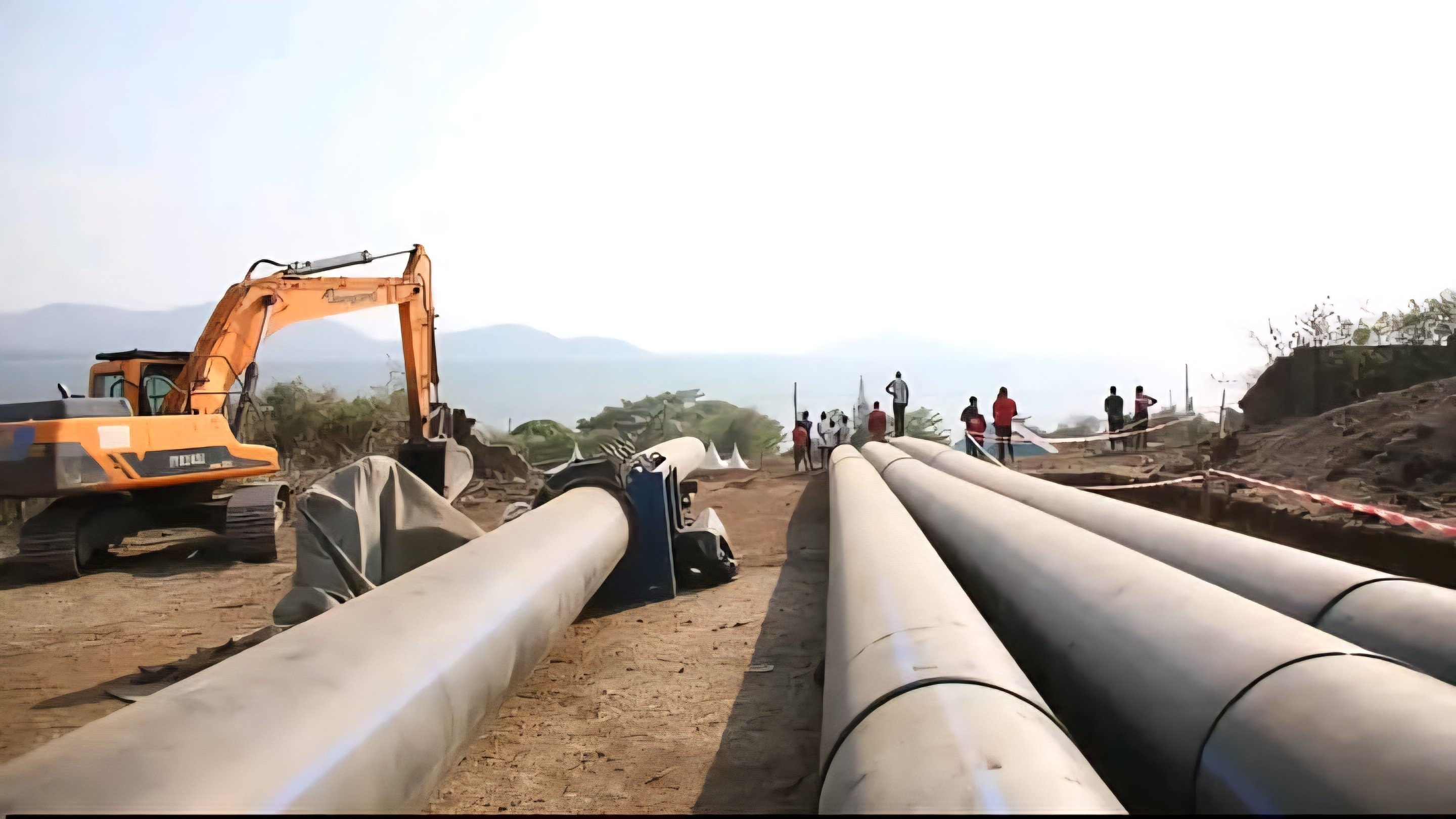

Works on the Suba Clusters Irrigation scheme in Sindo have reached advanced execution stages following ongoing pipe laying and site preparation along the shorelines of Lake Victoria.
National Treasury Cabinet Secretary (CS) John Mbadi recently inspected the site to assess physical progress on the ground.
The project is being developed under the supervision of the National Irrigation Authority (NIA) to expand agricultural production across Homa Bay County.
Civil works involve laying heavy-duty water pipelines and installing pumping infrastructure designed to draw water directly from Lake Victoria.
Once active, the new irrigation network will convert rain-fed farmlands into reliable, all-season agricultural plots. Local leadership aims to stabilize food production, while reducing household reliance on unpredictable weather cycles that frequently disrupt regional crop yields.
National Treasury Cabinet Secretary (CS) John Mbadi noted that expanding local production capacity remains vital for long-term national economic stability. He stressed that increased agricultural output will directly reduce food import pressures, while improving farm revenues across the western region.
Construction crews have concentrated on excavation and pipe alignment across targeted agricultural clusters within Suba South.
Heavy excavators continue trenching along main supply corridors, where large-diameter high-density polyethylene pipes are being positioned to feed designated farm blocks.
The inspection delegation included community leaders and technical site teams who reviewed civil engineering blueprints.
Discussions centered on completing bulk earthworks, securing specialized equipment, and maintaining the construction schedule for the primary distribution network.
Water scarcity challenges have historically limited commercial agriculture in Suba, forcing smallholder farmers to depend heavily on subsistence crops.
The infrastructure expansion addresses critical water delivery barriers, which have restricted high-yield commercial farming for decades.
Government agricultural planners expect the scheme to support diverse crop varieties once full pumping capacity becomes operational.
Horticulture and high-value produce are planned for systematic introduction under structured water distribution schedules, which will be managed through local farmer clusters.
Contractors are finalizing intake infrastructure near the shoreline, which will ensure uninterrupted raw water supply during extended dry seasons.
Engineers on-site confirmed that pipe jointing and ground compaction efforts remain on schedule along all primary distribution lines.
Community representatives in Sindo expressed confidence regarding economic opportunities created during both the construction phase and future farming cycles. Local labor has been integrated into pipeline installation, trench backfilling, and structural site preparation activities across the project footprint.
National Treasury Cabinet Secretary (CS) John Mbadi emphasized that public funding will remain aligned with priority agricultural infrastructure to guarantee successful completion.
Priority remains focused on completing main trunk lines before distribution networks connecting directly to individual farms are installed.
The Suba Clusters project represents a major investment in rural agricultural infrastructure within the Nyanza region. Broadening irrigated acreage across western Kenya remains essential to stabilizing domestic food supplies, while improving rural household incomes.
Engineers will proceed with hydrostatic testing on completed pipeline segments before connecting primary intake pumps to the main grid.
Site operations at Sindo are expected to maintain current momentum as final civil works progress toward completion.
Comments (0)
Leave a Comment
No comments yet. Be the first to share your thoughts!