
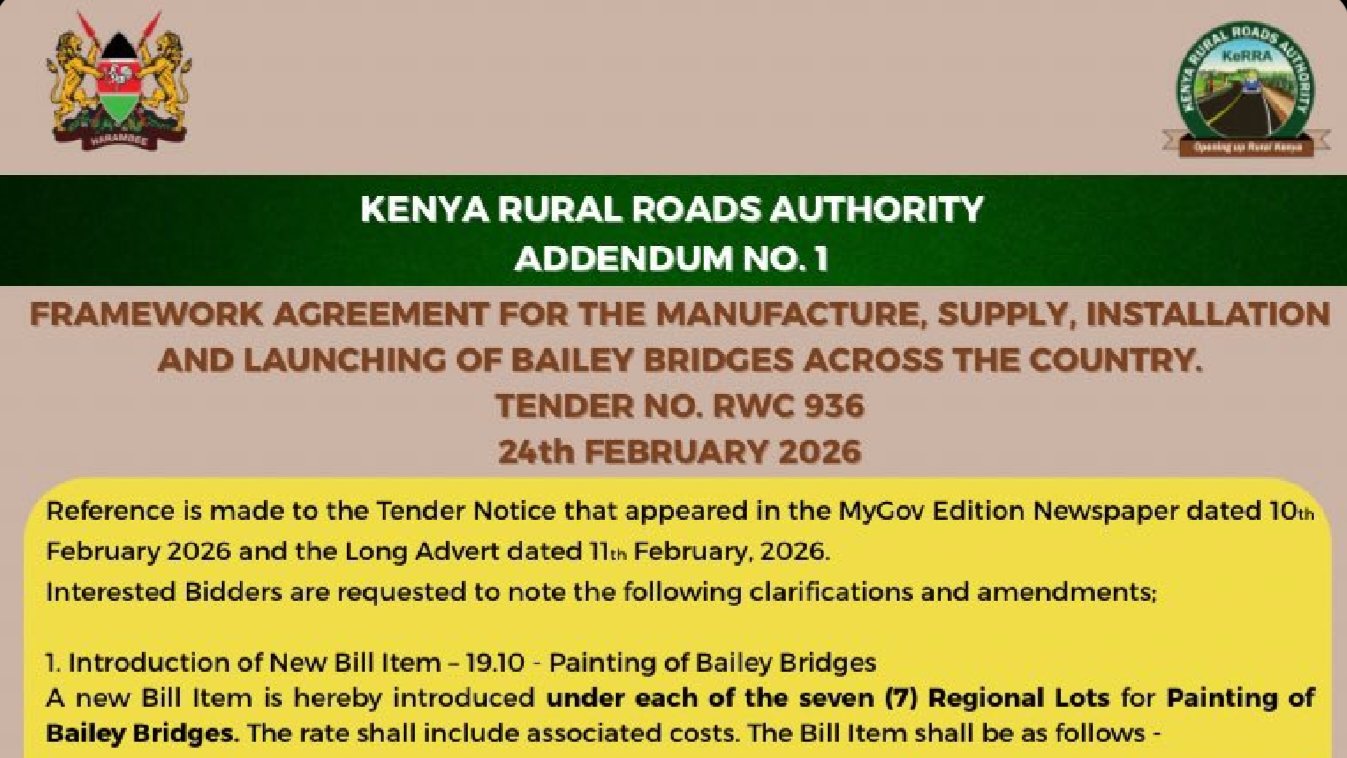

The Kenya Rural Roads Authority (KeRRA) has issued a formal addendum for the nationwide framework agreement concerning the manufacture, supply, installation, and launching of Bailey bridges. The notice, documented under Tender No. RWC 936, introduces specific technical amendments and a significant shift in the procurement timeline that will affect contractors bidding for works across the country.
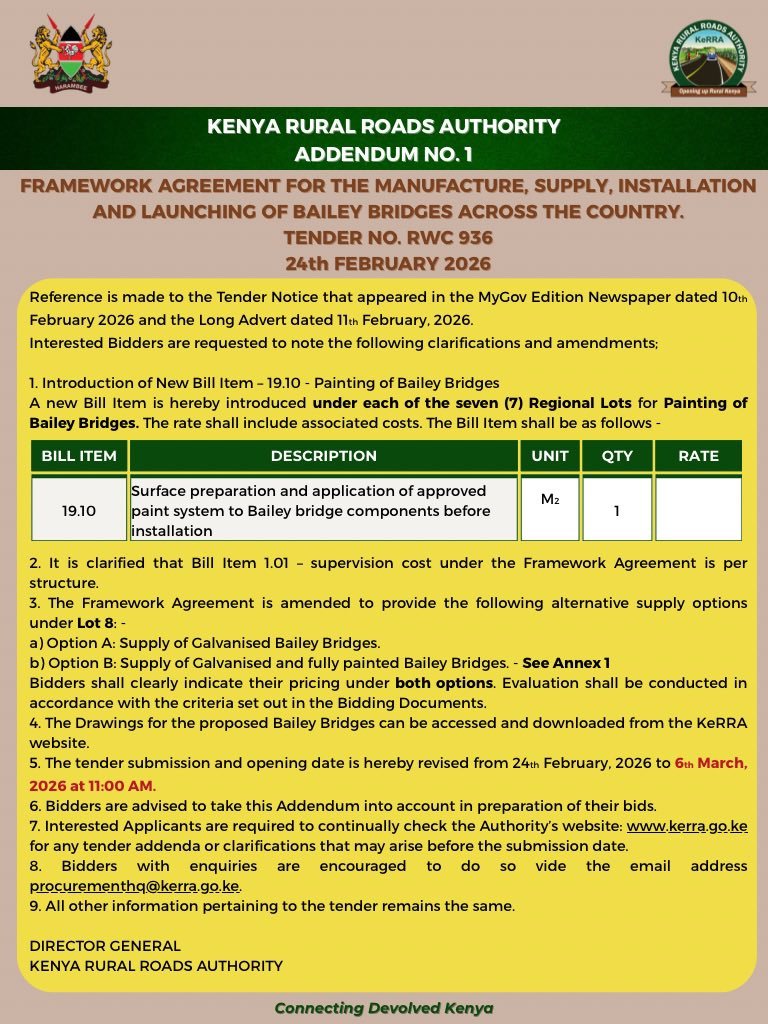
According to the director general of the authority, the deadline for tender submission and opening has been moved from 24th February, 2026, to 6th March, 2026, at 11:00 AM. This extension provides bidders with additional time to incorporate several new technical requirements that were not present in the original advertisement published earlier in the month.
A primary addition to the tender is the introduction of a new bill item, specifically designated as 19.10, which covers the painting of Bailey bridges. This item is now mandatory across all seven regional lots. Contractors are required to include the costs for surface preparation and the application of an approved paint system to bridge components before they are installed. The unit of measurement for this specific work has been set as square meters, though the initial quantity is listed as a single unit for the sake of rate entry.
The authority also clarified the interpretation of supervision costs within the framework agreement. It is now explicitly stated that Bill Item 1.01, which covers supervision, is to be calculated per structure. This clarification is expected to assist bidders in more accurately forecasting their overheads and site management costs for the duration of the contract.
Further changes have been made to the supply options under Lot 8. Bidders are now required to provide pricing for two distinct alternatives. Option A involves the supply of standard galvanised Bailey bridges. Option B requires the supply of bridges that are both galvanised and fully painted, with additional technical details provided in an annex to the bidding documents. Evaluation of these bids will be conducted based on the criteria set out for both options, necessitating a comprehensive pricing strategy from interested firms.
KeRRA has directed that all drawings related to the proposed Bailey bridges are now accessible for download directly from their official website. This move toward digital distribution of technical documents is part of an effort to ensure all interested applicants have immediate access to the necessary engineering specifications.
Prospective bidders who have already begun preparing their documents are advised that all other information pertaining to the tender remains unchanged. However, the authority has emphasised that this addendum must be taken into account, as failure to adhere to the revised bill items or the new submission date could result in disqualification.
For those requiring further technical or procedural clarity, the authority has opened an inquiry window via their procurement department email. This channel remains the primary method for resolving discrepancies before the new March deadline. The use of Bailey bridges remains a critical component of the national strategy to improve connectivity in rural areas, particularly where permanent concrete structures may not be immediately feasible due to budget or terrain constraints. These modular, pre-engineered bridges are often used to restore access quickly following seasonal flood damage or in regions where heavy equipment transport is limited.
The revision of this tender comes at a time when the government is under pressure to improve the durability of rural infrastructure. By introducing stricter painting and galvanisation requirements, KeRRA appears to be prioritising the long-term corrosion resistance of these steel structures. This focus on lifecycle maintenance is a standard practice in modern civil engineering, especially in tropical climates where humidity and rain can lead to rapid oxidation of unprotected steel components.
Comments (0)
Leave a Comment
No comments yet. Be the first to share your thoughts!