
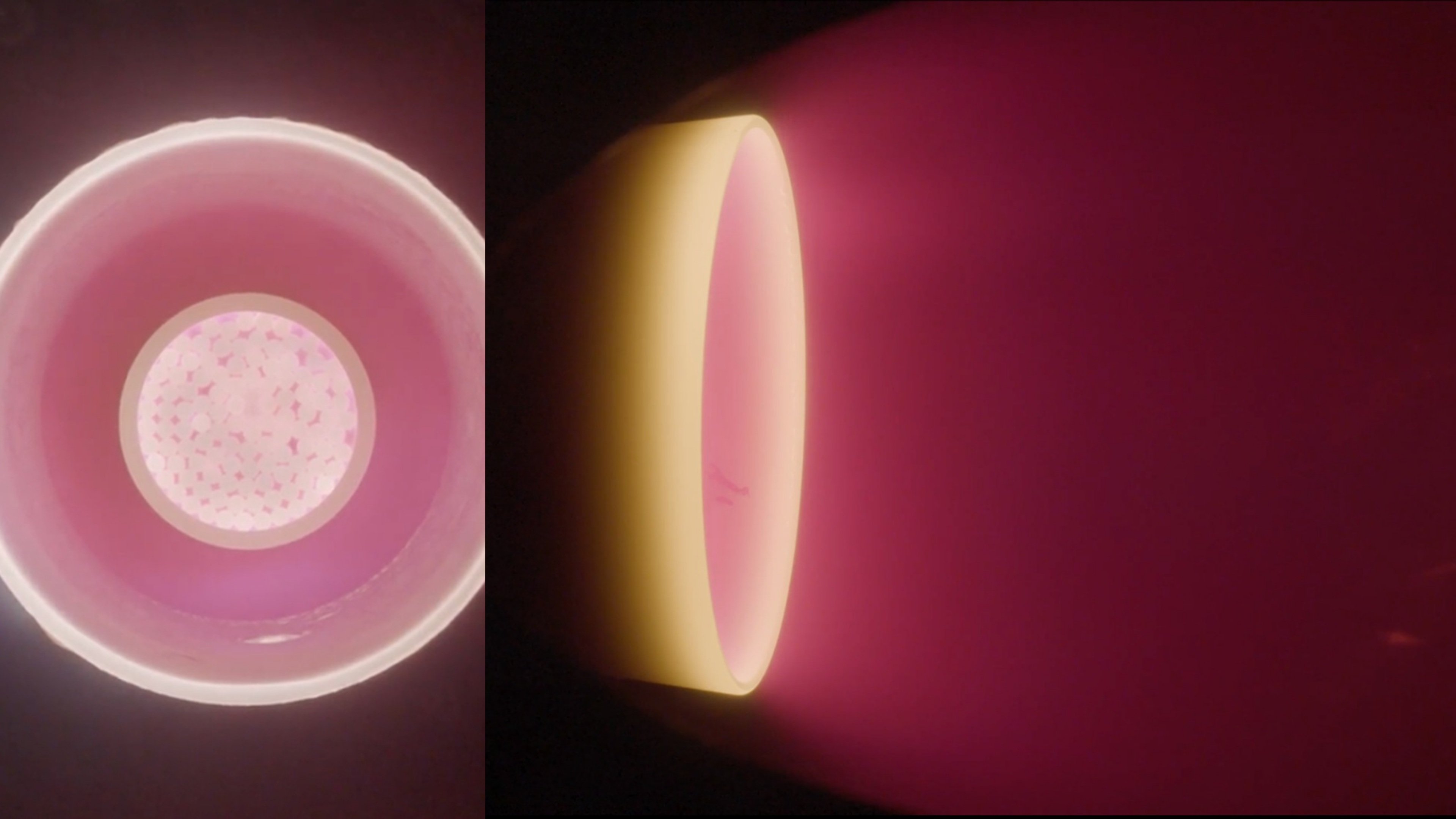

Engineers at the National Aeronautics and Space Administration (NASA) completed initial testing of an experimental lithium-fed electromagnetic thruster designed to support deep space exploration.
The prototype engine achieved operational levels reaching five times the electrical power of propulsion systems deployed on active spacecraft, when tested under simulated vacuum conditions.
The technology relies on lithium metal vapor, which turns into ionized plasma when exposed to strong electrical currents. Electromagnetic forces then accelerate the charged particles out of the nozzle, generating steady thrust.
Unlike traditional chemical rockets that burn large volumes of liquid fuel in short bursts, electric propulsion operates continuously over long durations.
This approach consumes up to 90 percent less propellant, which significantly reduces total spacecraft launch weight.
Testing took place at the Jet Propulsion Laboratory (JPL) in California, where researchers evaluated the hardware inside a specialized water-cooled vacuum chamber.
During multiple test firings, the central tungsten electrode reached temperatures exceeding 2,800 degrees Celsius while emitting a visible red plasma plume.
The recent trials reached an operational power level of 120 kilowatts, but future development targets call for scaling individual thrusters to between 500 kilowatts and one megawatt.
Spacecraft designed for crewed interplanetary flights would require multiple units combined to handle multi-megawatt power loads.
Integrating these high-power electromagnetic thrusters with an onboard space nuclear reactor could drastically shorten transit times for crewed missions to Mars.
Reduced transit times limit radiation exposure for astronauts, while allowing missions to transport heavier equipment and life-support payloads.
Development of the lithium-fed Magnetoplasmadynamic (MPD) drive is managed by JPL, in collaboration with Princeton University and the Glenn Research Center (GRC).
Funding for the project comes through the Space Nuclear Propulsion (SNP) program, which supports critical technologies required for future long-duration exploration.
While electric propulsion concepts date back several decades, practical applications remained limited by power output constraints and thermal durability challenges.
Modern advances in high-temperature materials and power conversion systems now allow engineers to operate these engines at significantly higher electrical thresholds.
Researchers must now prove that the hardware can operate reliably across thousands of firing hours before the design can be integrated into actual flight manifests.
Long-duration endurance testing will serve as the next phase, as development teams work toward refining electrode longevity and thermal management systems.
Comments (0)
Leave a Comment
No comments yet. Be the first to share your thoughts!