
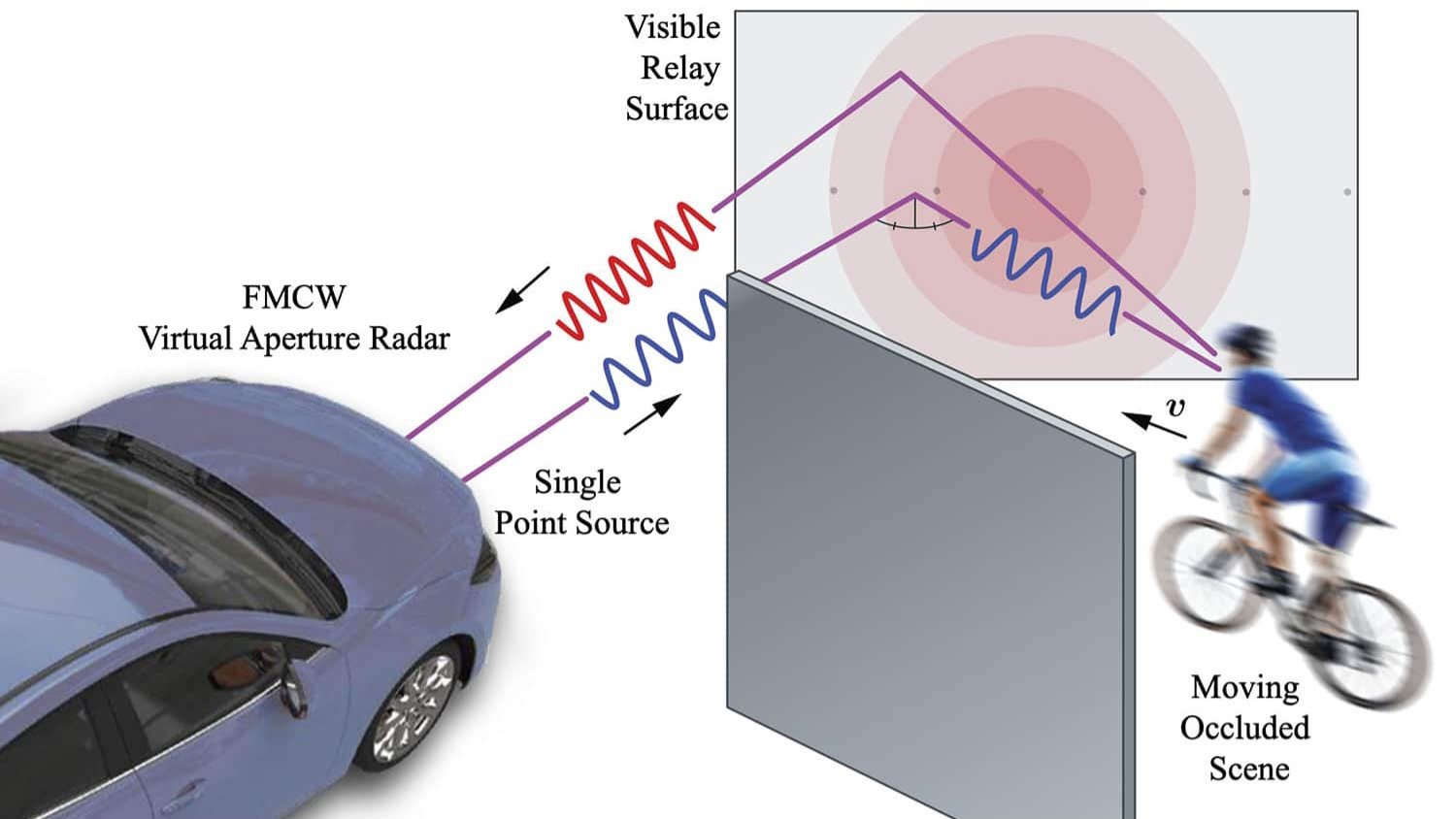

Researchers at the University of Pennsylvania have introduced a new technology designed to address one of the most persistent hurdles in autonomous vehicle development, the inability to perceive objects blocked by physical barriers. Known as HoloRadar, the system leverages radio waves and artificial intelligence to grant mobile robots and self-driving platforms the capacity to see around corners without a direct line of sight.
While current autonomous systems rely heavily on LiDAR and cameras, these sensors are generally limited to objects within their immediate visual field. LiDAR pulses must bounce directly off a surface and return to the source to register an object, which leaves vehicles blind to hazards emerging from side streets or hidden driveways. HoloRadar utilizes the unique properties of radio waves, which have longer wavelengths than visible light. When these waves encounter smooth surfaces like concrete walls or tiled floors, they reflect in a predictable, mirror-like fashion rather than scattering.
The hardware utilizes a standard 77 to 81 GHz millimeter-wave radar device, a frequency range already common in the automotive industry. This choice of frequency is intended to allow for easier integration into existing vehicle architectures without requiring specialized environmental modifications. The system functions by sending out radio pulses and receiving the echoes that have bounced off multiple surfaces.
To make sense of the complex web of returning signals, the research team developed a two-step AI processing method. A neural network first sharpens the raw radar data to reduce noise. The system then separates the signals into independent images based on the number of times the waves bounced before returning. This allows the technology to isolate direct reflections from those that traveled around a corner, effectively reconstructing a three-dimensional map of the hidden area.
During testing, the system demonstrated a high degree of precision in identifying individuals hidden behind corners. The researchers reported a 93 percent accuracy rate in person detection, with an average positional error margin of only 14 centimeters. Crucially for high-speed transit environments, the processing occurs in real time, with the environmental map updating approximately every 180 milliseconds.
The ability to peer into blind spots provides autonomous driving computers with a critical window of several seconds to react to potential collisions. This development comes as global regulatory bodies begin to formalize the deployment of driverless systems. The United Nations recently announced a draft global regulation for Automated Driving Systems, which seeks to establish uniform safety provisions for vehicles operating without human supervision.
While the initial testing phase of HoloRadar focused on indoor hallway environments and T-shaped intersections, the University of Pennsylvania team is now looking toward more complex outdoor applications. Urban environments present significant challenges, including longer distances and highly dynamic conditions that can interfere with signal clarity.
Future iterations of the technology will need to account for varied outdoor surfaces and the presence of multiple moving actors at once. Nevertheless, the integration of non-line-of-sight sensing into the standard sensor suite of autonomous vehicles represents a shift in how these machines interact with the built environment. By expanding the perceptual reach of the vehicle beyond the physical horizon, the technology aims to reduce the frequency of accidents at intersections and in dense urban settings where visibility is frequently compromised by permanent infrastructure.
Comments (0)
Leave a Comment
No comments yet. Be the first to share your thoughts!