
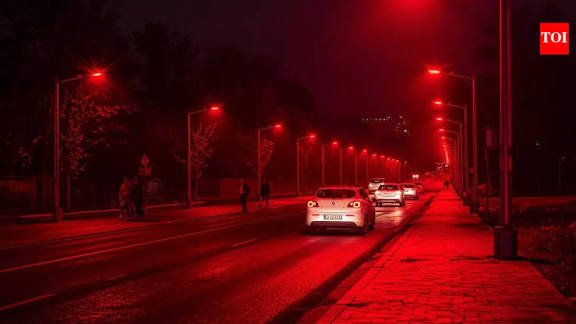

The Danish government has initiated a targeted overhaul of its public lighting infrastructure, opting for red LED lamps in place of conventional white light. This transition is not a decorative choice but a deliberate environmental intervention aimed at protecting the country’s bat populations. Research into nocturnal ecosystems suggests that white and blue light spectrums significantly interfere with the natural behavior of these mammals, often driving them away from essential feeding and breeding grounds.
Local municipalities across Denmark have begun implementing these changes in areas identified as critical wildlife corridors. Bats are particularly sensitive to short-wavelength light, which they perceive as a deterrent. By shifting to a longer wavelength, specifically red light, the infrastructure maintains visibility for motorists and pedestrians while remaining largely invisible or non-disruptive to the bats. This allows the animals to navigate and hunt without the disorientation typically caused by standard urban lighting.

The project follows similar pilot programs conducted in other parts of Northern Europe, where biodiversity loss in urbanizing areas has become a priority for planning departments. In Denmark, the rollout has been concentrated in suburban and rural fringes where human development directly borders protected natural habitats. Engineers involved in the installation noted that the red LEDs provide sufficient illumination for road safety requirements while drastically reducing light pollution.
Traditional high-pressure sodium or standard white LED lights attract insects, creating an artificial concentration of prey that can disrupt the broader food chain. Conversely, these lights can also expose bats to predators or cause them to abandon roosts. The red light alternative seeks a middle ground, fulfilling the technical requirements of public infrastructure without compromising the biological needs of the local fauna.
Data collected from initial installation sites indicates that the red light spectrum does not impair the vision of drivers, though it does alter the visual aesthetic of the night landscape. The Danish Road Directorate and local environmental agencies are monitoring the long-term impact of the switch to determine if the bat populations stabilize or increase in the coming seasons.
As European Union regulations regarding biodiversity and light pollution become more stringent, the Danish model is being viewed as a practical application of "dark sky" principles within active construction and utility management. The cost of the transition is being managed through standard maintenance cycles, with the more energy-efficient LED technology providing a secondary benefit of reduced municipal electricity consumption.
Comments (0)
Leave a Comment
No comments yet. Be the first to share your thoughts!