

A version of this commentary appeared on X by energy analyst Ted Benard Oduor.
The proposal challenges traditional state interventions in Kenya, where public entities frequently receive capital injections without fundamental operational changes.
Kenya's National Oil Corporation (NOCK) holds strategic national value, but injecting fresh capital into an unimproved commercial model rarely succeeds. State bailouts fail to cure weak consumer demand, which means structural reforms must precede financial refinancing.
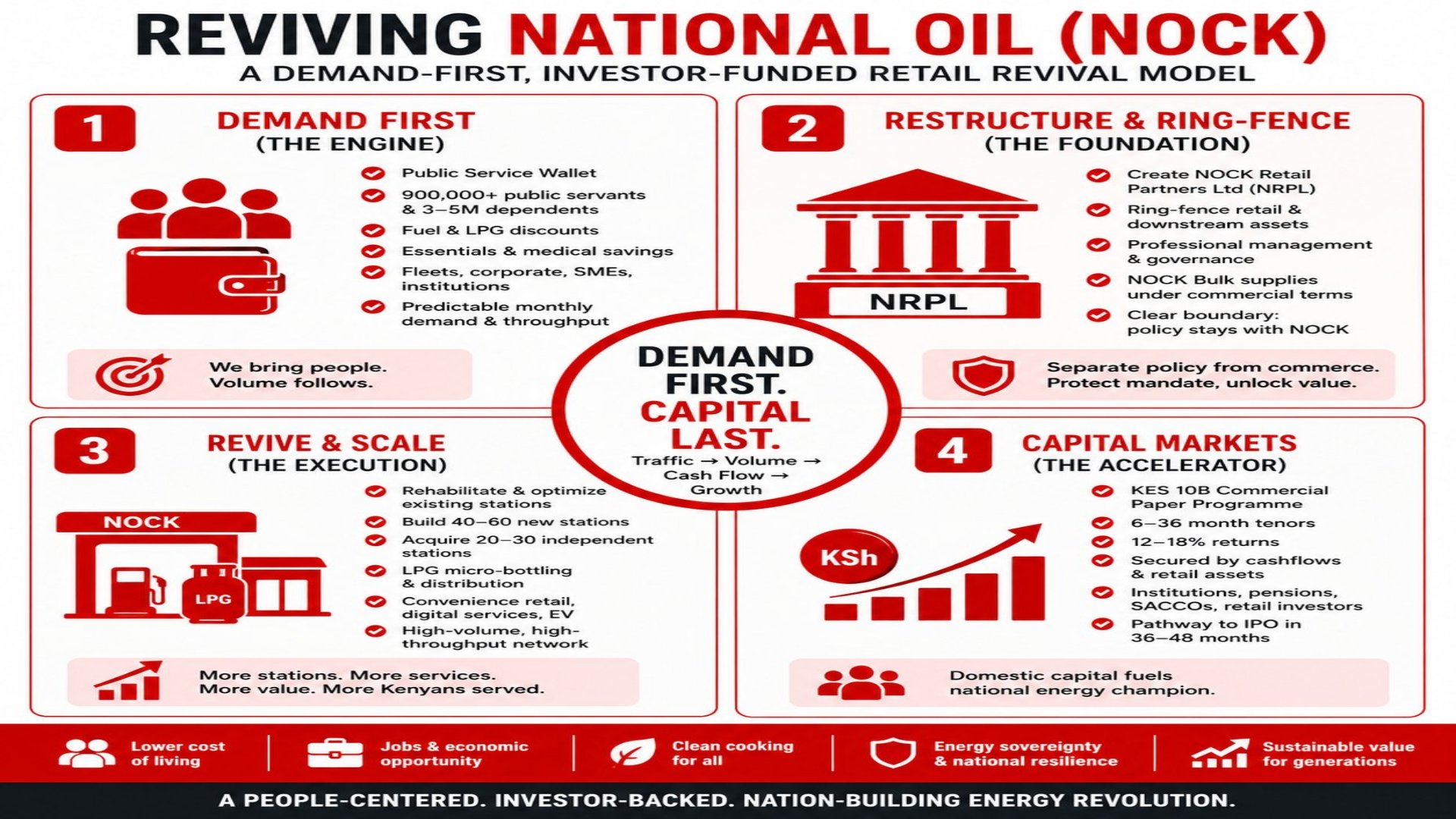
The recovery framework prioritizes customer acquisition over immediate cash injections. Building a solid customer base generates steady trade volume, which then creates stable cash flow to attract commercial capital for retail network expansion.
To establish predictable demand, the state marketer should aggregate purchasing power across public and private sectors. Government fleets, civil servants, state entities, and Savings and Credit Co-operative Societies (SACCOs) provide immediate volume.
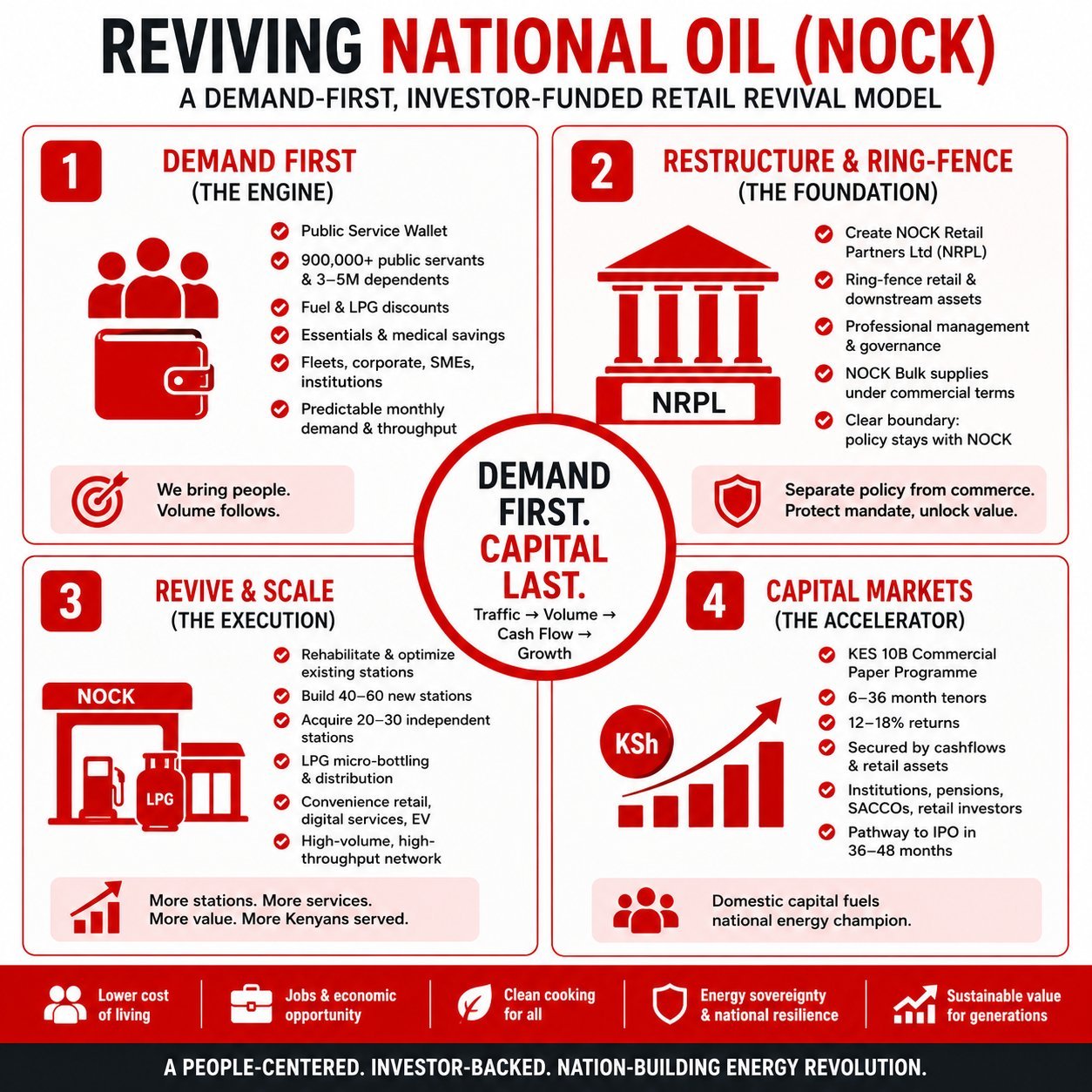
Corporate fleets, Small and Medium Enterprises (SMEs), and millions of domestic households can further solidify fuel and Liquefied Petroleum Gas (LPG) sales. Securing these off-takers establishes a reliable market before expanding physical infrastructure.
Operational restructuring requires ring-fencing retail activities into NOCK Retail Partners Limited (NRPL). This commercial subsidiary would oversee service stations, LPG distribution, convenience outlets, fleet management, and customer relations, while the parent corporation maintains its broader national strategic mandate.
Once operational discipline and commercial cash flows are established, institutional capital can follow. Funding mechanisms like commercial paper, pension fund investments, strategic partnerships, and an eventual public listing would scale a working business model rather than fund a failing asset.
However, critics contend that the sequence faces practical operational hurdles on the ground. Energy market commentator Kelvin Mwenda Karani noted that aggregating customer demand proves difficult, if storage facilities and underground fuel tanks remain empty.
Skeptics argue that private stock financing must come first to fill dry tanks, because customers will not visit empty petrol stations. Without immediate working capital to procure petroleum products, fuel stations cannot fulfill supply commitments to fleet contracts.
This counterargument underscores the operational reality of petroleum retail, where supply reliability directly affects consumer trust. Retail station managers cannot secure long-term commercial agreements, if fuel pumps experience frequent stockouts.
Proponents of the demand-first strategy maintain that contracted demand provides the collateral necessary to secure stock financing from oil traders. Having guaranteed off-take agreements reduces risk for financial institutions providing inventory credit.
The ongoing debate highlights broader policy questions surrounding state-owned infrastructure across East Africa. While capital remains available in regional financial markets, debate continues over whether customer guarantees or inventory financing should lead the recovery process.
Government officials and energy regulators continue to evaluate models for public-private collaboration in downstream petroleum distribution. Sustainable turnaround plans must balance short-term fuel supply with long-term governance reforms.
According to proposed models, aligning commercial governance with consumer demand offers a structured path toward financial independence. Rebuilding customer trust remains essential, if state corporations are to reduce reliance on public bailouts and taxpayer support.
Ultimately, industry stakeholders agree that sustainable recovery depends on balancing working capital needs with long-term commercial efficiency. Restructuring retail operations could determine whether the national petroleum marketer successfully re-establishes its market presence.
Comments (0)
Leave a Comment
No comments yet. Be the first to share your thoughts!