

A version of this article appeared on Nation.Africa.
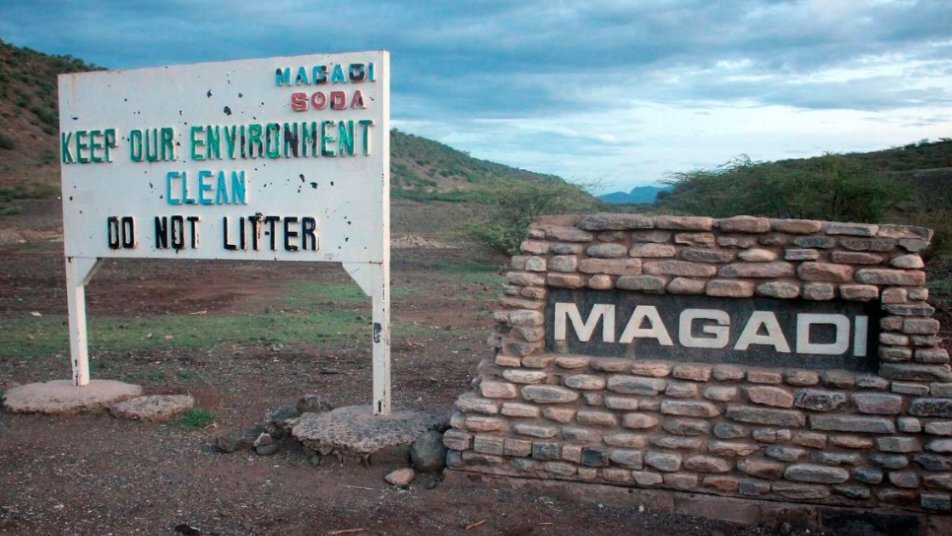
Deep in the dry Rift Valley basin of Kajiado County, Lake Magadi operates under an administrative system inherited from British colonial rule. A private security gate controls entry into the mining township, where industrial soda ash extraction continues under historic lease agreements.
Commercial mining at the site began after colonial authorities signed the 1911 Maasai Agreement, granting land concessions for mineral exploitation. Today, the operational infrastructure is managed by Tata Chemicals Magadi Limited (TCML), a subsidiary of Indian multinational Tata Chemicals.
The company extracts trona, a sodium sesquicarbonate mineral, directly from the bed of Lake Magadi. Processing plants at the site convert raw trona into refined soda ash, when high temperatures in rotary kilns drive off carbon dioxide and water vapor.
To export the processed mineral, the company relies on a dedicated railway branchline connected to the national rail network. Freight trains haul soda ash from the lake basin to storage facilities at the Port of Mombasa (PoM), where shipments are prepared for international buyers.
Local residents and leaders in Kajiado County have repeatedly challenged the operational boundaries and land rate arrangements surrounding the mineral concession. Disputes over unverified boundary beacons and revenue distribution highlight long-standing friction between surrounding pastoral communities and corporate management.
Mining operations utilize solar evaporation pans to harvest coarse sodium chloride alongside industrial soda ash. Highly concentrated alkaline brines are pumped through pre-concentration ponds, where natural heat accelerates solid mineral deposition throughout the processing cycle.
County officials contend that the current lease structure limits local tax collections, while it restricts public oversight within the private industrial enclave. The gated entrance remains guarded, which limits general public access to the settlement and surrounding lake shores.
Water supply systems and social services inside the township are maintained directly by the corporate management unit. Workers and their families reside within the self-contained complex, while external visitors require official authorization before passing through the security checkpoint.
The facility remains Africa's primary source of natural soda ash, supplying manufacturing sectors across glass production and chemical processing. Heavy machinery, including specialized dredgers, continuously scrapes trona crusts from the water surface to feed the calcining plant.
Broader national debate surrounding colonial-era mineral leases continues to focus on Lake Magadi. Government agencies, including the Ministry of Mining, Blue Economy and Maritime Affairs (MMBEMA), face calls from civil society groups to review historical land concessions across the country.
Pastoralist groups insist that land tenure agreements drafted prior to independence require structural realignment with modern constitutional frameworks. They argue that local communities should receive higher royalties, when resource extraction occurs within their traditional ancestral lands.
Company officials maintain that ongoing operations adhere strictly to statutory regulations and active lease terms. They emphasize that corporate investments sustain regional employment, while generating vital foreign exchange earnings through soda ash exports.
The governance model at Lake Magadi underscores ongoing tensions between heavy industrial infrastructure and community land rights. Infrastructure development in remote resource-rich regions faces increasing scrutiny over equitable economic distribution and transparent land administration.
As industrial demand for soda ash grows globally, the future of Magadi's legal and physical infrastructure remains a central discussion point. Regional authorities aim to balance corporate operational certainty with community development demands across Kajiado County.
Comments (0)
Leave a Comment
No comments yet. Be the first to share your thoughts!