
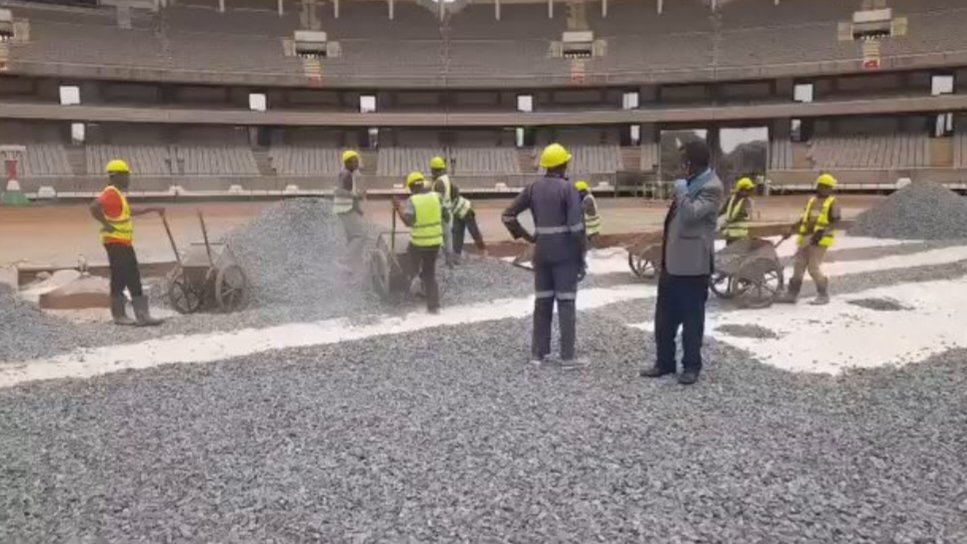

Questions surrounding the ongoing pitch reconstruction at the Moi International Sports Centre (MISC) Kasarani have surfaced following online discussions about construction methods on site. Public interest grew after social media users observed workers spreading coarse aggregate ballast across the playing surface area.
The physical works are part of extensive facility upgrades managed ahead of the Africa Cup of Nations (AFCON) 2027 tournament. Preparations require strict compliance with international pitch specifications set by governing sports bodies.
Ground engineering for modern stadium pitches relies on precise multi-layered sub-base designs. The installation of coarse stone, commonly referred to as ballast or crushed aggregate, forms a fundamental structural layer within high-performance drainage systems.
Contractors first lay down a heavy-duty geotextile membrane across the excavated stadium sub-grade. This synthetic geotextile fabric acts as a filtration barrier, preventing fine soil particles from migrating upward while allowing water to pass freely through the subterranean profile.
Perforated drainage pipes are positioned within excavated trenches beneath the sub-base layer. The crushed stone ballast is then distributed over the geotextile membrane to encase the pipe network completely.
Using coarse gravel creates high structural void ratios within the ground profile. These physical voids permit rapid vertical water percolation, directing heavy rainfall away from the upper playing surface into the underlying drainage channels.
Without a free-draining stone aggregate raft, rainwater would saturate the upper rootzone layer during heavy downpours. Uncontrolled water retention causes severe waterlogging, rendering natural grass fields unplayable and compromising player safety.
Different stadium designs utilize varying sub-base materials depending on local soil conditions, structural design, and specific turf systems. While some venues use specialized sand-gravel matrices, others apply traditional crushed stone sub-bases to achieve identical performance outcomes.
Once the gravel drainage layer is established, contractors apply a fine blinding layer, followed by a specialized sand-dominated rootzone medium. This upper layer supports healthy turfgrass root development while maintaining high hydraulic conductivity across the profile.
Sports Kenya technical officers and project managers continue to supervise ground levelling, gradient slope adjustments, and sub-base compaction on site. The structural works aim to deliver a resilient playing surface capable of handling intensive tournament match schedules under variable weather conditions.
Comments (0)
Leave a Comment
No comments yet. Be the first to share your thoughts!