
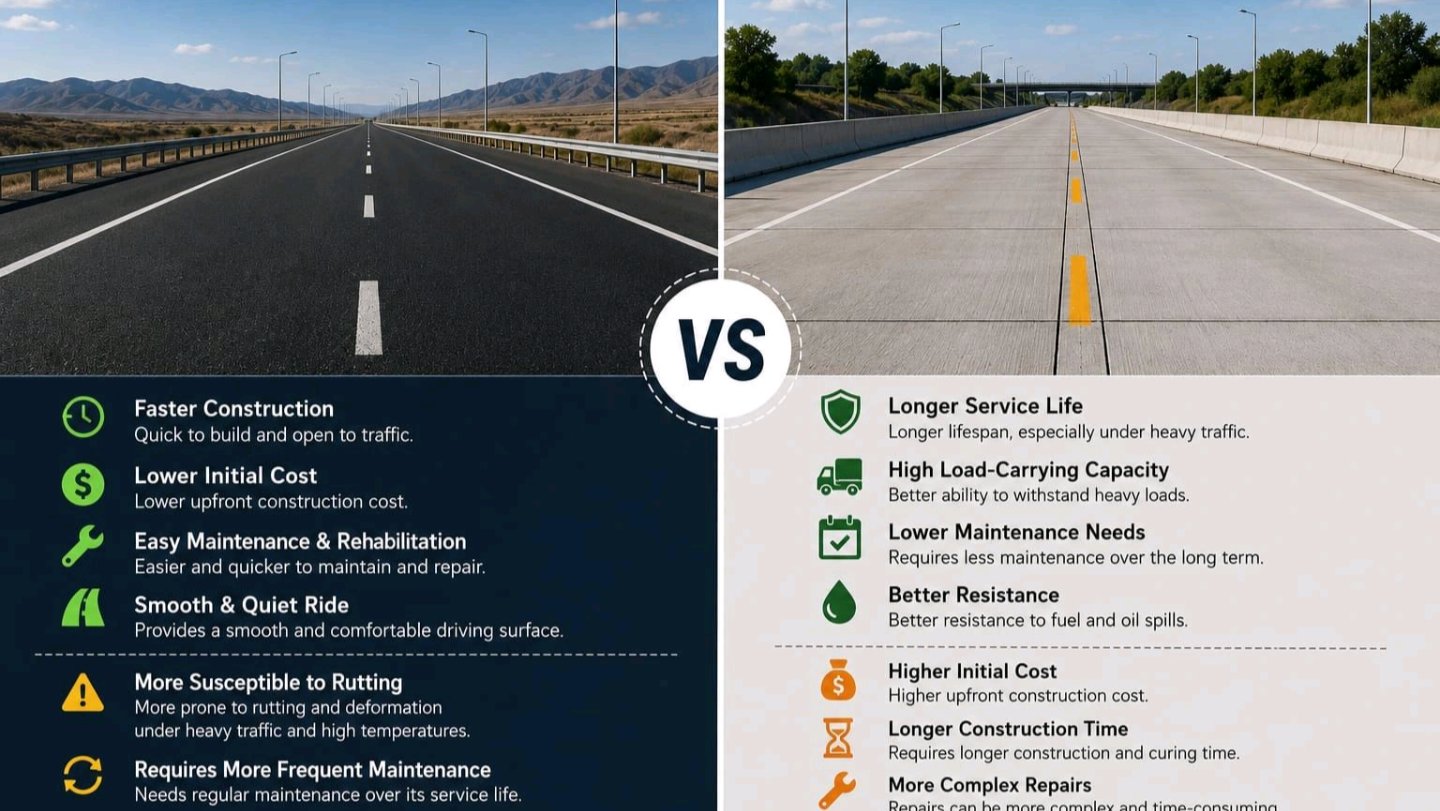

One of the most common questions in road engineering is whether to build with asphalt or concrete. The choice is rarely clear-cut. According to an industry breakdown shared by Ahmed Fayed, a Roads Project Manager, the final decision depends heavily on traffic loading, design life, maintenance strategy, climate conditions, and overall project objectives.
Engineers evaluate these structural materials under two primary categories: flexible pavement, typically asphalt, and rigid pavement, which refers to concrete. Each material presents specific structural trade-offs that planners must balance during the design phase.
Asphalt pavement offers distinct advantages for fast-tracked infrastructure developments. It allows for faster construction and opening to traffic, ensuring minimal disruption on high-volume thoroughfares. Additionally, asphalt carries a lower initial construction cost, making it attractive for budget-constrained projects. Maintenance and rehabilitation are also easier and quicker to execute on flexible surfaces.
Drivers generally experience a smoother and quieter riding surface on well-laid asphalt. However, the material remains vulnerable to environmental and structural stress. It is more susceptible to rutting and deformation under heavy traffic and high temperatures, requiring more frequent maintenance throughout its service life.
Concrete pavement provides an entirely different set of performance metrics. Its primary benefit is a longer service life, particularly when subjected to heavy traffic over extended periods. Rigid pavements possess a high load-carrying capacity, which gives them a better ability to withstand heavy heavy-commercial vehicle axle weights.
Long-term economics favor concrete in specific applications due to its lower maintenance needs over time. It also exhibits better resistance to fuel and oil spills, preventing the chemical degradation that often plagues flexible surfaces.
These long-term benefits come with significant upfront commitments. Concrete demands a higher initial construction cost, which can strain short-term capital allocations. The material also requires a longer construction time, largely due to the mandatory curing periods necessary for the concrete mix to achieve its design strength. When damage does occur, repairs are often more complex and time-consuming than standard asphalt overlays.
Engineers must assess these variables on a project-by-project basis to ensure public infrastructure delivers maximum value.
Comments (0)
Leave a Comment
No comments yet. Be the first to share your thoughts!