
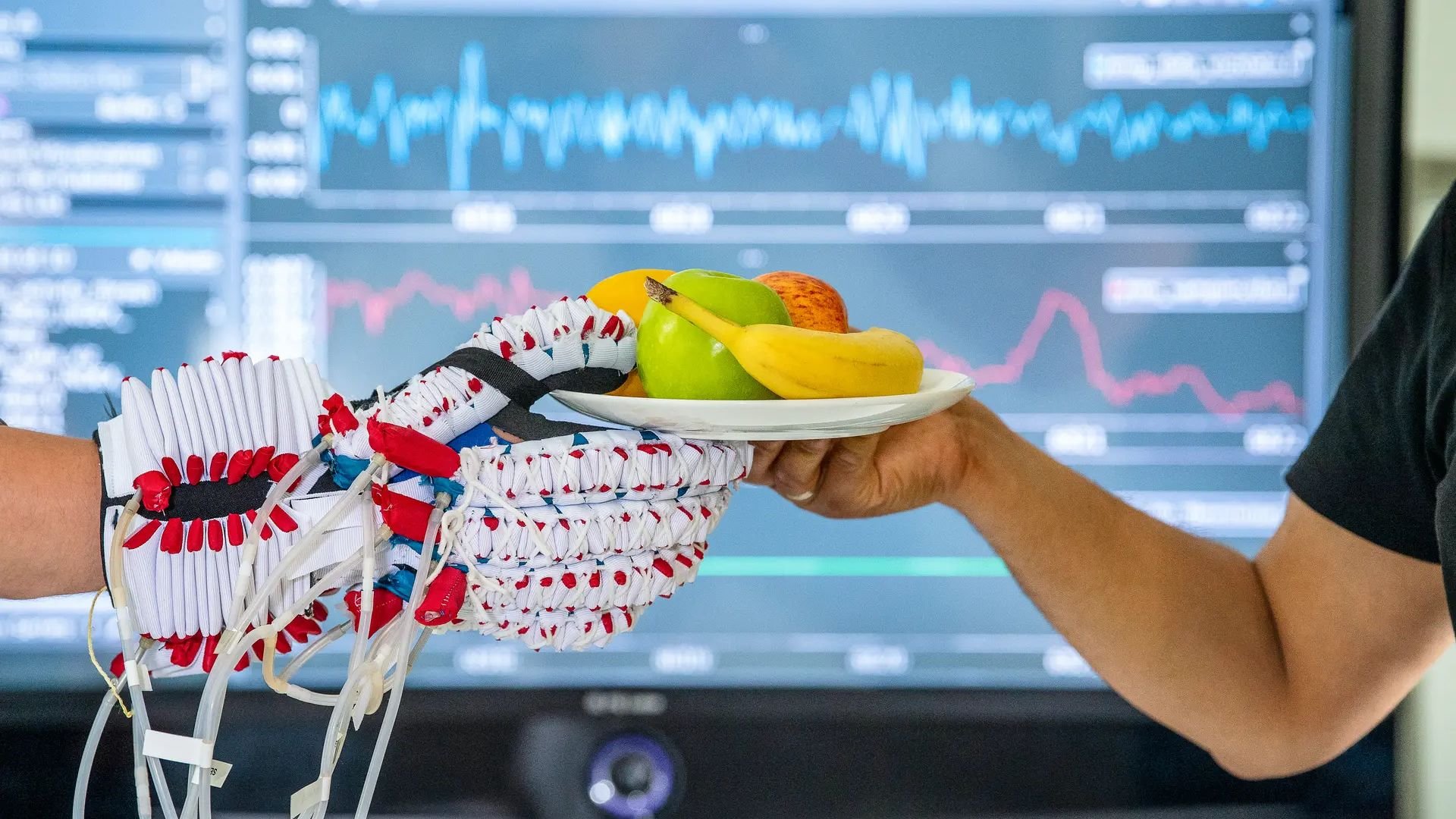

Researchers at the Technical University of Munich (TUM) have developed a soft robotic exoskeleton glove designed to restore gripping ability for individuals suffering from hand paralysis. The wearable device uses an artificial intelligence system to interpret muscle signals from the forearm, allowing patients to control the apparatus with high precision.
The pneumatic glove features soft air cushions integrated into a textile structure, replacing the rigid, heavy components traditional to robotic orthotics. By inflating these internal air chambers, the glove assists the hand in bending fingers and executing grasping motions safely.
To operate the device, electromyography sensors are placed on the skin of the user to detect faint electrical activity within the forearm muscles. A specialized machine learning algorithm processes these biological data inputs to predict the user's intent.
According to the research team, the system reads forearm muscle signals with a 97 percent accuracy rate. This high level of precision allows the glove to deploy mechanical support almost instantly, if the user attempts to grasp an object.
During clinical testing, the exoskeleton enabled a patient diagnosed with Amyotrophic Lateral Sclerosis (ALS) to hold a fork. The milestone allowed the individual to feed himself independently for the first time in four years.
The development marks a notable shift toward affordable, wearable rehabilitation technology for neurological disorders. The soft robotic framework reduces production costs compared to motorized hardware, which could make the device highly accessible for home-based therapy, although further clinical evaluations remain necessary.
Engineers are currently optimizing the algorithm to adapt to a wider range of muscle degradation profiles. The goal is to expand use to stroke survivors and individuals with spinal cord injuries, who struggle with permanent mobility loss.
By utilizing flexible fabrics, the design ensures comfort during prolonged daily use. The lightweight profile prevents fatigue, but it still delivers the mechanical force needed to secure a firm grip on smooth household items, like cups and utensils.
The research project highlights how combining soft robotics with machine learning can bypass damaged neural pathways. Even when physical movement is severely restricted, residual muscle signals provide enough data to restore basic autonomy, if paired with the right assistive technology.
The Technical University of Munich team plans to initiate larger multi-center trials soon. Securing broader clinical data will help refine the device for mass manufacturing, which could fundamentally change the standard of care for global paralysis rehabilitation.
Comments (0)
Leave a Comment
No comments yet. Be the first to share your thoughts!